
What if better traction in your garage didn’t mean choosing a rough, difficult-to-clean floor? A slip-resistant garage floor coating can improve grip through carefully selected texture, but the coating material alone doesn’t determine how the surface feels underfoot. Water on smooth concrete can create a slipping concern, while heavy texture may hold dirt and make routine cleaning harder.
The goal is to match the floor’s texture to how you use your garage. We’ll explain how traction additives affect a coated surface, what to consider when balancing grip with easy maintenance, and why the right choice depends on your space and routine. We’ll also cover how concrete condition and professional surface preparation factor into a coating system. With a clear understanding of these choices, you can decide whether a light-texture finish fits everyday use or whether your garage would benefit from a professional assessment.
Key Takeaways
- Water, tracked-in slush, oil, and other surface contamination can reduce traction on garage floors.
- A slip-resistant garage floor coating relies on appropriate texture and additives, not simply on choosing epoxy, polyurea, or polyaspartic.
- Match the finish to your garage’s traction needs, cleaning routine, appearance preferences, and everyday use.
- Assess the concrete and moisture concerns before choosing a system, since surface condition helps determine preparation and repair needs.
- Our coating systems can be designed to improve slip resistance with proper additives, but no coating can promise a slip-proof floor.
What makes a garage floor slippery, and when can a coating help?
A garage floor can feel secure when dry and become slick when water, oil, or other contaminants get between footwear and the surface. A slip-resistant garage floor coating is a professionally selected and installed coating system designed to improve traction, often by adding texture to the finished surface. It can change the floor’s finish, but it can’t remove every slipping risk or prevent spills from affecting footing.
Traction depends on both the floor and what’s on it. A textured finish may contribute grip, while a puddle, greasy mark, or film of dirt can still change how shoes contact the surface. Start by identifying the conditions your garage actually faces. Don’t assume every textured product performs the same way.
Why does a garage floor become slippery?
Water and contaminants can reduce grip by forming a layer between a shoe and the floor. In Chicago, rain, snow, and melting slush can be tracked into a garage on tires and footwear. A small oil leak or residue from everyday use can also create a temporary hazard, even if the underlying floor finish hasn’t changed.
That distinction matters. A floor may have a smooth finish with limited texture, or a more textured finish that still gets slippery when contaminated. Clean up spills promptly and keep an eye on areas where vehicles, wet footwear, and stored equipment bring moisture or residue indoors.
What can a slip-resistant coating change?
A coating system can add a selected texture that gives footwear more surface to engage with. Proper additives are one way to create that texture. The amount and character of the texture should suit the garage’s use: a home workshop may need a different balance of traction and cleanability than a space used mainly for parking. A thicker, rougher feel isn’t automatically the right answer for every homeowner.
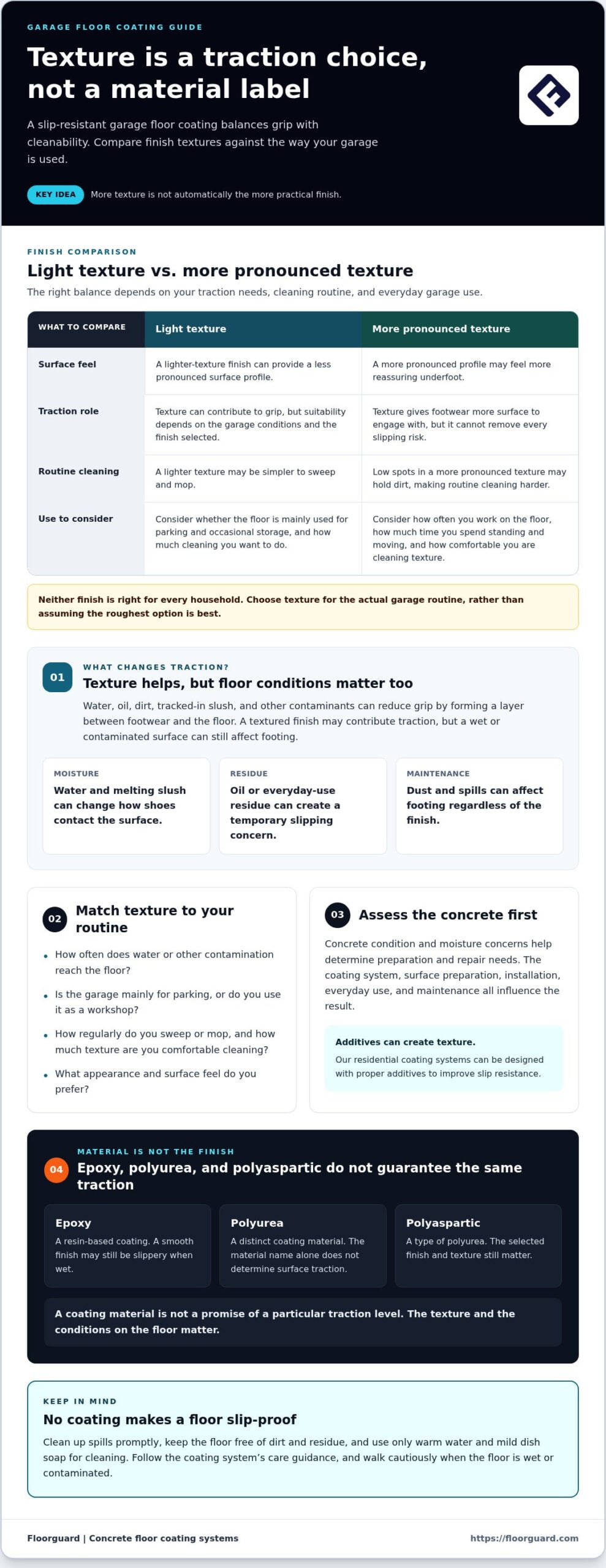
Coatings are one type of floor covering, and the coating material itself doesn’t guarantee a particular level of traction. Epoxy, polyurea, and polyaspartic are distinct materials, and a smooth finish made with any of them may still be slippery when wet. Our residential coating systems can be designed with proper additives to improve slip resistance. Results depend on concrete preparation, system selection, installation, daily use, and maintenance.
Texture also affects upkeep. A more pronounced profile may hold dirt in its low spots, while a lighter texture can be simpler to sweep and mop. The practical choice is the finish that supports your traction needs without making routine care harder than necessary. Even with a carefully chosen system, wipe up liquids and walk cautiously when the floor is wet or contaminated.
How does texture improve traction without making the floor impractical?
A textured coating changes the feel of the finished surface. Its small variations give footwear more points of contact than a uniformly smooth finish may provide, helping improve grip as you walk. The effect depends on the texture selected and the conditions on the floor, so treat texture as one part of traction, not a promise that slips can’t happen.
Texture can contribute to traction, but the right amount depends on how the floor is used and maintained. Choosing a slip-resistant garage floor coating involves more than picking a coating material or asking for the roughest finish available. Consider how often the floor gets wet, whether you work on it, and how you prefer to clean it.
Texture, additives, and the finished surface
Proper additives can be incorporated into a coating system to improve slip resistance by creating texture. The selected coating and the way it’s finished both matter. Epoxy is a resin-based coating; polyurea and polyaspartic are different materials, and polyaspartic is a type of polyurea. They aren’t interchangeable names for the same product, and none automatically provides the same traction in every finish.
Accessible routes have their own considerations. The U.S. Access Board explains the need for stable, firm, slip-resistant surfaces in its ADA Accessibility Standards for Floor and Ground Surfaces, while recognizing that slip resistance is difficult to define with one universal value. For a home garage, the useful takeaway is to select a finish for the space’s intended use rather than rely on a material label alone.
Why more texture is not automatically better
A pronounced texture may feel reassuring underfoot, but it can also make dirt more likely to remain in the surface’s low spots. A lighter texture may be easier to sweep or mop, but its suitability depends on your garage conditions and priorities. There isn’t one finish that fits every household.
Consider your routine. If the garage is mainly for parking and occasional storage, your cleaning habits and the amount of water tracked inside may point to a different finish than a workshop where you spend more time standing and moving around. Ask yourself whether you sweep regularly, whether tracked-in moisture is common, and how much texture you’re comfortable cleaning. These details help frame the coating choice.
Maintenance remains part of the traction picture. Dust, spills, and residue can affect footing regardless of the finish, so clean the floor as needed and follow the coating system’s care guidance. Avoid using harsh chemicals for cleaning; use only warm water and mild dish soap.
Our team can assess how you use your garage and discuss how texture fits the coating system. Talk with our team about garage floor traction and the finish that makes sense for your space.
Which garage coating finish balances traction, cleaning, and appearance?
Choose a coating system and finish together. The material affects performance and installation characteristics, while texture and finish shape how the floor feels, looks, and cleans. A slip-resistant garage floor coating depends on the full system, including proper additives when needed, rather than a material name alone.
How should homeowners compare coating materials?
Epoxy is a resin-based coating. Polyurea is known for fast curing, flexibility, adhesion, and impact resistance. Polyaspartic is a type of polyurea often used as a UV-stable coating or topcoat. Each has different characteristics, so the right fit depends on the concrete, garage use, exposure, and project priorities. None automatically delivers the same traction in every finish.
Our polyurea and polyaspartic systems are UV stable and non-yellowing. For context, OSHA’s guidance on slip resistance does not establish one mandatory coefficient-of-friction value for every floor. A material label alone therefore won’t tell you how a finished surface will perform under your specific conditions.
How should finish and cleaning needs shape the choice?
We offer Vinyl Flake, Marble Flake, Metallic coating, and Solid Color finishes. These options differ in appearance, but the finish name by itself doesn’t specify traction. The selected texture and any proper additives contribute to the surface feel. Consider how the garage is used and how much texture you’re comfortable cleaning.
| Choice | Traction considerations | Cleaning and appearance | Garage use to consider |
|---|---|---|---|
| Epoxy | Traction depends on the selected finish and whether proper additives are used. | A resin-based coating can be paired with different finishes; texture affects routine cleaning. | Consider the slab, exposure, and the way you use the space. |
| Polyurea | Material alone doesn’t determine grip. Finish selection remains important. | Discuss the desired surface feel alongside appearance and upkeep. | Its flexibility, adhesion, impact resistance, and fast curing may inform system selection. |
| Polyaspartic | Traction still depends on finish and additives, not the material name alone. | Our system is UV stable and non-yellowing; select texture with cleaning in mind. | Consider exposure to sunlight as well as your garage’s daily demands. |
For finish appearance, Vinyl Flake and Marble Flake offer flake-based looks, while Metallic coating creates a different decorative effect and Solid Color provides a uniform color. Ask how the planned texture will work with your preferred finish and cleaning routine. More pronounced texture can make dirt harder to remove from surface details; a smoother feel may not match every traction need.
Set priorities before choosing: note where moisture is common, how the garage is used, and whether easy sweeping or mopping matters most. Then weigh those needs against appearance and the concrete’s condition. The system should be selected and installed for the project, not assumed to suit every floor. Contact our team to discuss a garage coating finish for your space.
What should you assess before choosing a slip-resistant garage floor coating?
Start with how you use the garage, then consider the concrete, moisture concerns, preferred finish, and cleaning routine. These factors help determine which coating system and texture make sense for your space. A coating recommendation should follow an assessment of the floor, not a one-size-fits-all assumption about traction.
A garage used mostly for parking may have different needs from a workshop where you spend more time moving around on foot. The finish should account for likely water exposure and your willingness to clean textured surfaces. Explore our residential garage floor coating services as you consider the requirements of your project.
What does the garage need to handle?
Think about daily activity first. Is the space mainly for parking, storage, or a workshop? Do wet shoes or vehicle tires often bring moisture inside? Will you sweep regularly, or do you rely on occasional mopping? Your answers help clarify the balance you want between added texture, appearance, and upkeep. No single texture suits every garage or use pattern.
Why do concrete condition and preparation matter?
The existing slab helps determine whether a coating can be applied as planned and what preparation it needs. Our team assesses the concrete and considers moisture and existing coatings as part of developing a project-specific approach. That inspection can reveal cracks, pits, or other surface conditions that may need attention before coating. If your garage update is part of a broader property renovation or commercial buildout, consulting experienced general contractors such as themartinezcompany.org can help coordinate site preparation before specialty finishes are applied. The findings guide the system and preparation, rather than assuming every garage requires identical repairs.
Professional preparation commonly involves several steps, adjusted to the floor’s condition:
- Inspect the concrete. Review the surface for visible cracks, pits, worn areas, and existing coatings.
- Assess moisture and coatings. Check for moisture concerns and determine whether an existing finish could affect the new system.
- Evaluate repair needs. Decide whether cracks or pits need repair as part of preparing for the coating.
- Prepare the surface mechanically. Diamond grinding may be used to prepare the concrete for coating adhesion.
- Remove contaminants. Dust, oils, and other substances that could interfere with application need to be addressed before coating.
Preparation matters because the coating must bond to a properly prepared surface. Skipping assessment or applying a system over unresolved contamination can undermine the finished result. The chosen finish and texture should also fit the garage’s intended use and exposure. Results depend on preparation, product selection, installation, use, and ongoing care.
Before an assessment, note how you use the garage and any concerns you’ve noticed about the slab or existing finish. Those details help our team understand the project and discuss a suitable coating approach. If you’re weighing concrete condition, surface preparation, and texture together, discuss your garage floor coating project with our team.
How does Floorguard approach slip-resistant garage floor coating?
At Floorguard, we manufacture and install our own concrete coating systems. This manufacturer-installer approach lets our team consider the whole project, from the concrete beneath the finish to the texture you want underfoot. Our coatings can be designed to improve slip resistance when proper additives are used, but no coating can make a floor slip-proof in every condition.
What does a professional coating project involve?
We begin by assessing the garage’s use and the concrete’s condition. Inspection helps guide the coating system, texture, and preparation plan. Depending on the floor, preparation may involve checking moisture and existing coatings, addressing cracks or pits as part of the coating project, diamond grinding, and removing dust or contaminants before application.
Materials, layers, repairs, installation time, and cure time vary with the project and selected system. Installation time is not the same as return-to-service time: the coating needs to cure after application before the garage is used. For our systems, the stated timing is Install time 1-3 days depending on system and Walk-on by day 3, drive-on by day 4. For normal use, wait 2 full days in rooms above 70°F and 3 full days in rooms at or below 70°F. Follow the project-specific guidance from our team.
Pricing depends on concrete condition, square footage, and the chosen system. An assessment gives us the information needed to recommend a coating approach and explain the factors affecting your project, rather than treating every garage as identical.
What experience and care guidance can homeowners expect?
Our team brings 35+ years of experience and Over 30 million sq ft installed to residential and other concrete coating projects. We manufacture our own products in the USA. Our process focuses on assessing the slab, preparing it for the selected system, and applying the coating with the garage’s intended use in mind. We can help you weigh traction goals alongside appearance and everyday cleaning.
Our limited lifetime warranty covers peeling, delamination, and wear, subject to its terms. Warranty maintenance includes cleaning the floor at least four times per year with warm water and dish soap. Review the applicable terms for full coverage details.
If you’re considering a slip-resistant garage floor coating, share how you use the space and what concerns you have about the concrete or finish. Contact Floorguard to discuss a garage floor coating assessment.
Plan a garage floor that fits your everyday routine
Your garage changes with the seasons, your projects, and the way your household uses the space. Use that routine as the starting point for choosing a slip-resistant garage floor coating. Think about where moisture tends to collect, how you move through the garage, and how much time you want to spend cleaning. A thoughtful coating assessment can turn those everyday details into a practical system recommendation.
At Floorguard, we manufacture and install our own coatings, with products made in the USA. Our team can connect your concrete’s condition and your priorities to a coating system and finish suited to the project. That gives you a clearer path forward without treating traction as a one-size-fits-all choice.
Contact Floorguard to discuss your garage floor coating project. Our team can help you plan an approach that supports the way you use your garage and feels right for your home.
Frequently Asked Questions
Can a slip-resistant garage floor coating prevent every slip?
No. A slip-resistant garage floor coating can improve traction when proper additives are used, but no coating eliminates every slipping risk. Footwear, water, oil, residue, maintenance, and conditions at the time all affect footing. A wet patch near a vehicle still calls for care, even on a textured floor. Clean spills promptly and walk cautiously when the surface is wet or contaminated.
Does a textured garage floor coating make cleaning harder?
It depends on the finish and how you use the garage. Texture can influence how readily dust and residue sweep away, so consider your routine before choosing a surface. Sweep regularly and mop with warm water. For a stain, use mild dish soap and a soft-bristle brush. Avoid using harsh chemicals for cleaning; use only warm water and mild dish soap.
Is garage floor paint the same as a professional floor coating?
No. Floor paint is not the same as a professional coating system. Epoxy is a resin-based coating, while polyurea is a distinct coating material known for flexibility and adhesion. Polyaspartic is a type of polyurea, often used as a UV-stable coating or topcoat. These terms describe different materials, not interchangeable names. System selection depends on the concrete and project needs.
Can an existing coated garage floor receive a slip-resistant finish?
Possibly, but the existing coating and concrete need professional assessment first. The condition of the current finish, its bond, and any contamination can affect the preparation and suitability of another coating system. Our team assesses the existing coating and concrete to recommend an appropriate project approach. Don’t assume a new layer will bond correctly or that one overlay method suits every garage floor.
How long after installation can a coated garage floor be used?
Walk-on by day 3, drive-on by day 4. For normal use after curing, wait 2 full days in rooms above 70°F and 3 full days in rooms at or below 70°F. These are different milestones: limited foot traffic and vehicle use follow the system’s return-to-service guidance, while the temperature-based wait applies before normal use. Follow the specific instructions for your project.
Can a garage floor coating be installed in cold weather?
Yes. Our coatings can be installed successfully in cold weather and perform well at lower temperatures. In Chicago, garages may face cold conditions, so the selected system and project details determine the installation and curing schedule. Conditions vary from one job to another, and our team plans around the specific floor and coating system rather than applying one schedule to every project.


