
Polyurea coatings can help protect concrete from chemical spills, abrasion, impact, and water while staying flexible as the surface moves. These polyurea coating benefits can support durability, but performance depends on product choice, preparation, installation, and floor conditions. For a Chicago project, matching the coating system to the space and its intended use is a practical starting point.
It’s natural to want a coating that stands up to daily wear without making maintenance harder. This guide explains how polyurea works, where its protective qualities matter, and what fast curing and low-VOC emissions mean for your project. You’ll also see why choosing the right system and preparing the concrete properly are central to a durable finish.
Key Takeaways
- Match the coating system to the floor’s traffic, chemical exposure, moisture conditions, and project schedule.
- Account for fast curing when planning downtime, but distinguish application time from when the floor is ready for use.
- Consider the chemicals, abrasion, and impact your floor faces to understand the protection it needs.
- Assess water exposure carefully, since waterproofing performance depends on the coating system and application.
- Review product emissions and indoor project conditions when choosing a coating for enclosed spaces.
What Is Polyurea Coating and What Are Its Key Benefits?
Polyurea is a protective polymer coating applied to concrete and other prepared surfaces. Its flexibility, chemical resistance, and rapid curing can suit floors that need durable protection and a quicker return to service.
Rapid Curing and Reduced Downtime
Rapid curing means polyurea develops a usable surface soon after application, with some formulations reacting in seconds. That speed can shorten the period a garage, workspace, or industrial floor stays out of service. Application time and return-to-service time are different: the coating still needs to meet its product-specific cure requirements before foot or vehicle traffic resumes.
Hot-sprayed polyurea can dry in 3 or 4 seconds after application, while some coatings become tack-free in 30 seconds. These figures describe material behavior, not a universal schedule for every flooring project. Surface temperature, product formulation, coating layers, and site conditions affect curing, so project planning should account for the selected system’s instructions.
Low-Temperature Curing
Low-temperature curing describes a coating’s ability to cure when the surrounding conditions are cool. Polyurea formulations differ, so a fast cure in one setting doesn’t establish performance in another. Temperature matters because it can affect how the material reacts and how quickly the finished floor reaches its required cure state.
For a cold garage or industrial space, application conditions and the product’s technical requirements guide the schedule. Confirming the concrete and ambient conditions before application helps avoid treating a stated cure time as a promise for every site.
Comparing Polyurea, Epoxy, and Polyurethane
Floorguard installs polyurea and polyaspartic floor coating systems, as well as epoxy flooring. UV resistance, durability, and chemical resistance can vary by polyurea formulation and the conditions of use. Compare systems based on the floor’s condition, traffic, chemical exposure, sunlight, finish, and project timeline.
Choose a coating system based on the floor’s surface condition, traffic, chemical exposure, sunlight, appearance, and project timeline. A garage owner may prioritize a decorative flake finish and resistance to everyday spills, while a facility may focus on heavy traffic and chemical exposure. These practical needs help guide system selection.
Polyurea coatings suit prepared concrete floors and other compatible surfaces, including garages, commercial spaces, and industrial settings. They’re also used on areas such as tanks and containment surfaces where water or chemical exposure matters. Compatibility depends on the substrate and the system selected. For property owners who are also evaluating broader exterior protection and weatherproofing, Heroic Roofing provides residential and commercial roofing services designed to protect structures against moisture and environmental wear.
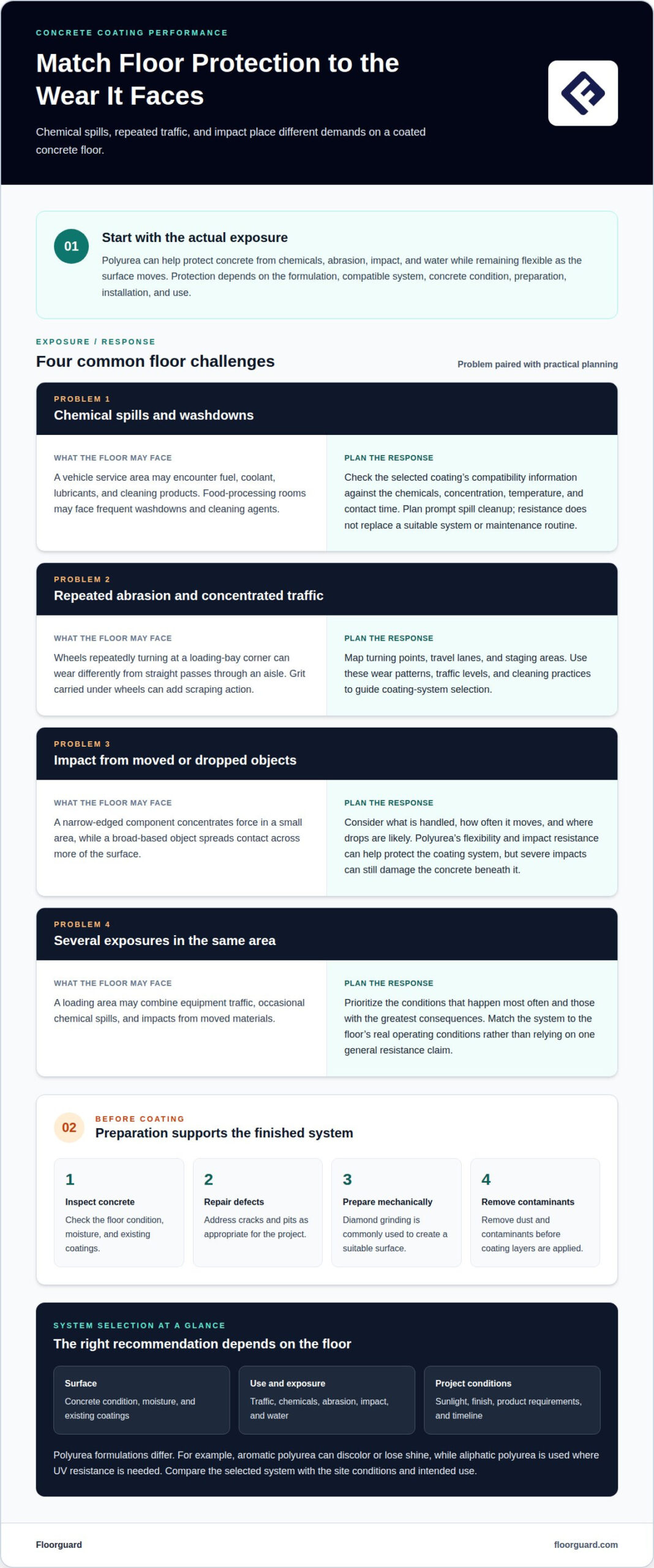
Limitations include rapid reaction during application, which leaves less working time, and differences between formulations. UV performance also varies: aromatic polyurea can discolor or lose shine, while aliphatic polyurea is used where UV resistance is needed. A coating doesn’t correct unsuitable concrete or eliminate the need for proper installation.
Preparation starts with concrete inspection, moisture and existing-coating checks, and repair of cracks or pits. Mechanical preparation, commonly diamond grinding, creates a suitable surface; dust and contaminants must then be removed before coating layers are applied. After curing, routine cleaning and prompt removal of spills help maintain the floor. Specific products and conditions determine the appropriate care.
Chemical, abrasion, and impact resistance
A coating’s resistance depends on the system and the floor’s exposure. An occasional spill poses different demands from frequent washdowns or repeated equipment movement. Identify the work taking place and the cleaning routine so the system can be matched to actual operating conditions.
For example, a vehicle service area may encounter fuel, coolant, lubricants, and cleaning products. A food-processing room may face frequent washdowns and cleaning agents. The coating’s compatibility information helps clarify which exposures it is designed to handle. Spill duration, concentration, temperature, and cleanup practices all affect how a chemical interacts with a coated surface.
Plan for spills as part of floor use. If a container tips in a work area, prompt cleanup limits contact time and reduces the chance of staining or surface damage. A written maintenance routine can identify who responds and which cleaning method is appropriate. That practical planning complements chemical resistance; it doesn’t replace choosing a compatible coating.
Abrasion comes from repeated surface contact. For example, pallet-jack wheels turning at the same loading-bay corner can wear a different pattern than straight passes through an aisle. Grit carried under wheels can add scraping action. Mapping turning points, travel lanes, and staging areas helps identify where a floor faces concentrated wear.
Impact is different from abrasion. A dropped component with a narrow edge concentrates force in a small area, while a broad-based object spreads contact across more of the surface. Consider the materials handled, how often objects are moved, and where drops are most likely. Polyurea’s flexibility and impact resistance can help protect the coating system, but concrete beneath it can still be damaged by severe impacts.
Floors often face several exposures at once. A loading area, for instance, may combine equipment traffic, occasional chemical spills, and impacts from moved materials. Prioritize the conditions that occur most often and those with the greatest consequences. This gives coating selection a practical basis instead of relying on a single claim about strength or resistance.
For a resistance recommendation suited to your floor’s use, discuss your project with Floorguard.
Waterproofing and immersion suitability
Water exposure ranges from brief splashes to continuous immersion, and those conditions call for different coating requirements. A garage floor that gets wet from rain doesn’t face the same service environment as a tank interior kept underwater. Immersion also means prolonged contact, which can challenge a coating differently than occasional spills. Define the exposure clearly before selecting a system.
Water protection depends on the complete application, not just the coating material. Drains, pipe openings, joints, corners, and changes in plane need attention because water can find paths around the coated area. A continuous coating can help protect the surface, but the application details must be considered as part of the project.
For submerged settings, consider the liquid’s contents, temperature, and movement, as well as how the space is used. Potable water storage, process-water containment, and a wet commercial floor are distinct applications. A system selected for one should not automatically be treated as suitable for another. The same distinction applies to corrosion protection, since water exposure may occur alongside contact with corrosive substances.
The McLeod Dam project in Belleville, Ontario, illustrates polyurea use in infrastructure waterproofing. Work began in 2011, with the coating applied at 80 to 100 mils in a single pass. Quinte Conservation expects the lining to provide at least 40 years of service with routine maintenance. That expectation belongs to this project and doesn’t establish a lifespan for other installations.
Industrial containment areas show why chemical and water exposure should be considered together. If stored liquid spills or remains against a coated surface, its composition and contact duration affect system requirements. A system intended for periodic wetting may not meet the demands of an immersed tank or sump. Plan how the coated area will be inspected and maintained.
For Chicago property owners and facility teams, the useful question is how water reaches the floor and what happens after contact. Is it a brief tracked-in wet area, recurring washdown, standing water, or sustained immersion? That distinction helps set realistic expectations for protection and directs attention to application details. Polyurea can serve waterproofing purposes, but suitability depends on matching the specific system to the exposure and intended use.
Low VOC emissions and indoor air quality
Volatile organic compounds, or VOCs, are chemicals that can evaporate into the air from some coating products. For an indoor project, a low-VOC formulation can reduce VOC emissions during application. Some polyurea coatings are described as 100% solids, with no solvents or volatile organic chemicals. That description applies to those formulations, not every product labeled polyurea.
Check the specific coating system’s product information to understand its VOC content and handling requirements. A garage floor, basement, and occupied commercial space each present different ventilation and scheduling needs. For example, a basement with limited airflow calls for careful planning around application, curing, and access. Low VOC emissions do not mean a product has no odors or that ventilation can be ignored.
VOC content is only one part of indoor air quality. During installation, surface preparation can create dust, while coating components require controlled handling. A complete work plan accounts for both preparation and application, including how the area is isolated and ventilated. For a business, scheduling work when fewer people use the space can help coordinate access and reduce disruption.
Product chemistry also matters. A 100% solids coating contains no solvent carrier that evaporates as the film cures, but application still involves reactive coating components. Follow the product’s technical and safety instructions for handling, ventilation, and protective equipment. The selected system’s requirements should guide job-site controls, rather than assuming that a low-VOC label removes the need for them.
Low VOC emissions also don’t determine whether a coating suits a floor. A basement may need a system chosen for its concrete condition and moisture, while a workshop may prioritize chemical resistance and abrasion performance. Flexibility, finish, and expected traffic matter too. Compare these project needs alongside VOC information before settling on a coating system.
Before application, the project team should inspect the concrete, assess moisture, and identify old coatings or contaminants. Mechanical preparation, such as diamond grinding, can create the surface profile needed for adhesion. Dust removal then helps keep debris from interfering with the coating layers. These steps support coating performance, but they don’t change the formulation’s VOC content.
After installation, keep people and belongings out of the work area until the coating reaches the required cure and return-to-use stage. That timing depends on the product and site conditions. For example, a household garage used for storage needs a different access plan from a commercial room with scheduled operations. Review VOC details, ventilation needs, preparation, and curing together to plan an indoor project responsibly.
Polyurea coating durability
Polyurea durability comes from more than a hard surface. Its flexibility and strength help a coating handle movement, abrasion, and impacts while protecting the concrete beneath it. Listed material properties include tensile strength of 6,000 PSI or more and elongation at break of 400%. These figures describe material characteristics, not a guarantee of how a particular floor will perform. The practical polyurea coating benefits depend on how the material is selected, installed, and used.
What factors affect polyurea coating performance and lifespan? Concrete condition, moisture, preparation, formulation, installation quality, traffic, chemical exposure, sunlight, and maintenance all influence results. For example, a lightly used basement and an industrial aisle carrying rolling equipment place different demands on a coating. Understanding these conditions helps determine which properties matter most and how to plan for the floor’s expected use.
Substrate preparation is central to durability. Existing coatings, contaminants, cracks, and moisture can affect adhesion if they aren’t addressed before installation. Mechanical preparation creates a suitable surface for bonding, while repairs address visible cracks or pits. The installed layers and their thickness also matter. A system should match the floor’s demands rather than relying on material strength alone.
Daily use shapes performance over time. A garage exposed to vehicle tires, road grime, and occasional oil spills needs a coating selected for those conditions. In a facility, repeated equipment traffic can concentrate wear along travel lanes. Dragging loads or dropping tools adds impact stress. These examples show why traffic patterns and use matter when selecting a coating.
Sunlight and environmental conditions can affect appearance and service behavior. Aromatic polyurea may discolor or lose shine under ultraviolet exposure, while aliphatic polyurea is used where UV resistance matters. Corrosion protection also depends on keeping the coating intact over the substrate. Chips or damaged areas can expose concrete or metal to moisture and corrosive substances.
Maintenance supports a coating’s protective properties. Remove dirt and spills using cleaning methods suited to the installed system, and address visible damage before it spreads. In a commercial space, observing equipment routes can reveal concentrated wear. At home, checking high-use garage areas can help identify scratches, chips, or chemical staining early. These practical habits help preserve the coating’s appearance and function.
Low volatile organic compound emissions describe a product characteristic, not its durability. The useful polyurea coating benefits come from a system suited to the substrate and actual exposure, supported by proper preparation, installation, and care. Contact Floorguard to discuss a durable coating system for your floor.
Floorguard
Floorguard helps homeowners and property managers evaluate concrete coating options for the conditions their floors face. Our team installs coatings for residential, commercial, industrial, and garage floors. A project assessment considers the concrete’s condition, moisture, traffic, chemical exposure, sunlight, and desired finish. Those details help shape a recommendation around the surface and how it will be used, rather than choosing a coating by name alone. If you’re weighing polyurea for a floor, we can discuss its performance needs alongside preparation, installation, curing, and return-to-service planning. Contact Floorguard to discuss your concrete floor coating project.
Plan the Right Coating for Your Floor
Your next step is to connect the coating choice to the floor’s actual job. Consider the space’s daily use, exposure, appearance goals, and how installation will fit your schedule. A clear picture of the project helps shape a recommendation around practical needs, not just a material name.
The polyurea coating benefits that matter most depend on how the floor will be used and the conditions it faces. The system also needs to suit the concrete and the project’s preparation requirements. These considerations help set realistic expectations for installation, curing, maintenance, and return to service.
Floorguard installs concrete floor coatings for residential, commercial, and industrial properties. Our team can help you discuss how the floor’s condition and intended use guide system selection. Bring your project goals and key concerns to the conversation so we can focus on what matters for your space.
Discuss your floor coating project with Floorguard, and take a confident next step toward a system suited to your needs.
Frequently Asked Questions
How soon can I walk or park on a new polyurea-coated floor?
Floorguard’s average guidance is walk on the floor by day 3 and drive on it by day 4. For normal use, wait 2 full days in rooms above 70°F, or 3 full days in rooms at or below 70°F. These milestones distinguish light foot traffic from vehicle use. Plan to keep cars, stored items, and routine activity off the surface until the applicable curing period has passed.
Will polyurea hold up to hot tires, forklifts, and temperature swings?
Floorguard’s polyurea and polyaspartic systems are designed for durable floor protection, and our coatings can be installed in cold weather. A residential garage exposed to hot tires has different demands than an industrial aisle with forklift traffic. Tell our team about vehicle or equipment use and temperature conditions so the system and project plan suit the floor’s intended use.
What are the main benefits of polyurea coatings?
Polyurea coatings offer flexibility, impact resistance, chemical resistance, UV stability, and quick curing. Those properties can help protect a concrete floor while supporting a faster project schedule. For example, a garage owner may value chemical resistance and easier upkeep, while a facility manager may focus on impact exposure and operating downtime. The right priorities depend on the space, concrete condition, and expected use.
How durable is polyurea coating, and how long does it last?
Polyurea coatings can provide long-term floor protection, and Floorguard states its coating can last a lifetime when properly maintained. The limited lifetime warranty covers peeling, delamination, and wear, subject to its care requirements. Durability depends on preparation, installation, use, exposure, and maintenance. A floor carrying heavy equipment or frequent traffic needs care suited to its conditions, including routine cleaning and attention to visible damage.
How resistant is polyurea to chemicals, abrasion, impact, UV, and moisture?
Polyurea coatings are designed to resist chemicals and impact, and Floorguard’s polyaspartic topcoat provides UV stability on flake floors. Abrasion performance depends on the system and the floor’s traffic. A coating can protect the surface from water exposure, but it shouldn’t be treated as a solution for every moisture condition or as a guarantee against water intrusion through concrete. Match the system to the exposure.
How much does polyurea coating cost per square foot in the United States?
Floorguard customizes pricing based on the concrete’s condition, the floor’s square footage, and the selected system. A damaged or uneven surface may require different preparation than sound concrete, and the chosen coating system also affects the project scope. Pricing is provided after a quote request rather than as a single per-square-foot rate. Share the space’s use and condition when discussing your project.
How is polyurea coating applied, and how long does installation take?
Installation generally involves inspecting and preparing the concrete, addressing cracks or pits, removing dust and contaminants, then applying the coating layers and allowing them to cure. Floorguard’s system installation takes 1-3 days depending on the system. Standard one- to four-car garage installations can be completed in one day; larger commercial or metallic projects may take longer. Installation duration is separate from the time before normal use.


