
A polyaspartic floor coating is typically ready for walking 24 hours after the final coat, even though its surface may dry much sooner. If you’re wondering what the curing time for polyaspartic floors is, use that 24-hour window as a practical guide for foot traffic, not the moment the coating feels dry.
For Chicago homeowners planning a garage project, getting the floor back into use quickly matters. But dry to the touch, ready for foot traffic, and fully cured aren’t the same milestone. This guide explains how temperature, humidity, coating thickness, and the floor system can affect the timeline, then compares polyaspartic and epoxy cure times. You’ll also learn when to allow vehicle traffic and why following the coating system’s cure instructions helps protect the finished floor.
Key Takeaways
- Learn why a dry surface may still need more time before it can handle regular foot traffic.
- See how temperature, humidity, and coating thickness can shift the curing timeline.
- Understand why walking on the floor and driving or parking on it call for different waiting periods.
- Compare polyaspartic’s faster return-to-use timeline with epoxy’s longer cure.
- Discover which project conditions matter when planning installation and getting the space back into service.
How Long Before Walking on Polyaspartic Floor Coating?
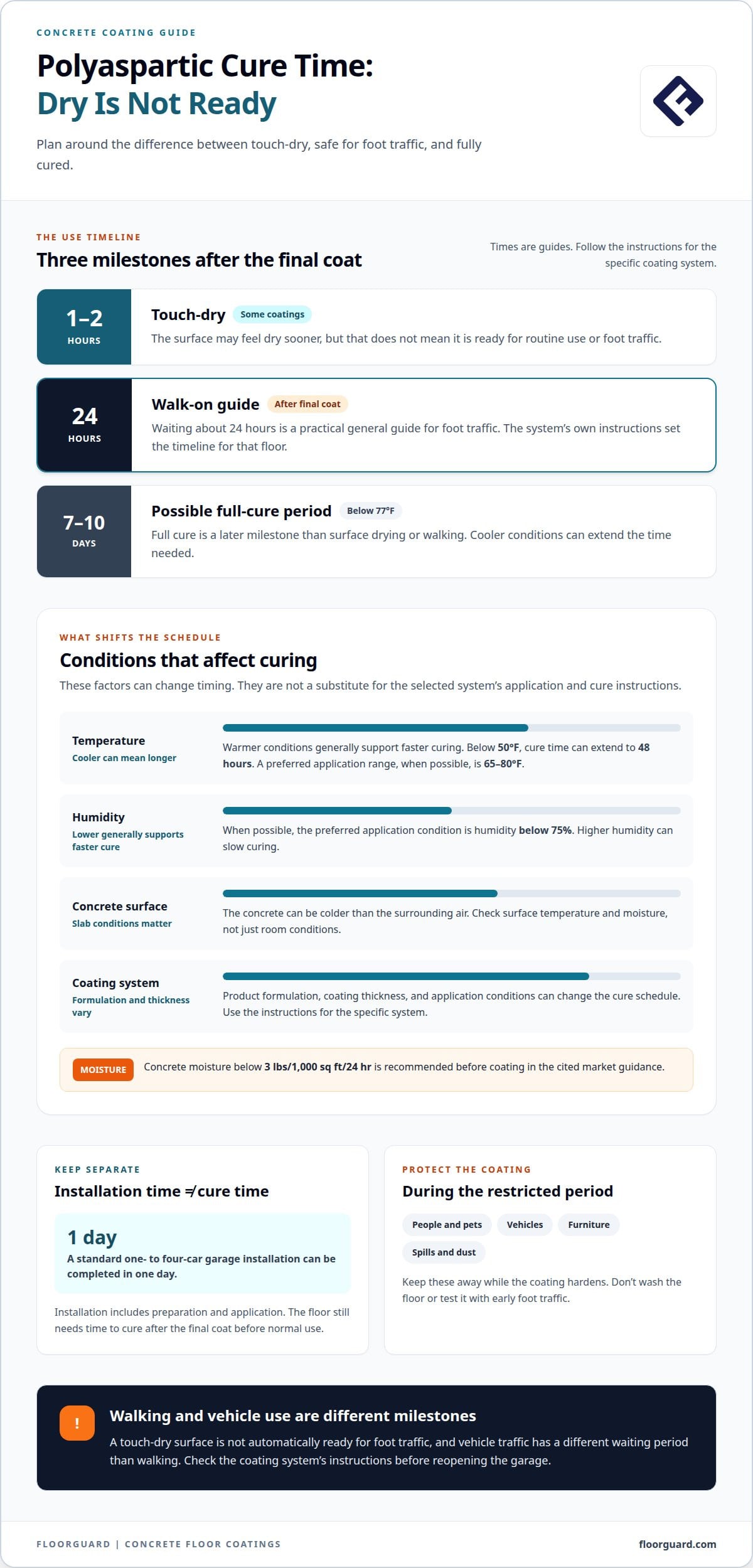
As a general guide, wait 24 hours after the final coat before walking on a polyaspartic floor. The surface may dry sooner, but touch-dry does not mean the coating is ready for routine use. Knowing when the floor can reopen helps you plan access for people, pets, and stored items.
Cure Time and Installation Duration
Cure time is the period after application when a coating hardens; installation time includes preparation and application. They are separate parts of the schedule. Standard one- to four-car garage installations can be completed in one day, but the floor must still cure before normal use.
Installation can involve inspecting the concrete, repairing cracks or pits, mechanically preparing the slab, removing dust, and applying the coating layers. The slab’s condition and chosen system shape the work sequence. A one-day installation does not mean the floor is ready for immediate use.
Some polyaspartic coatings become touch-dry in 1-2 hours, while full cure can take longer. “What is the curing time for polyaspartic floors?” is a useful question, but ask whether the answer refers to drying, walking, or full cure.
Time Before Walking on the Coating
The walk-on period begins after the final coat and ends when foot traffic is allowed. Waiting about 24 hours is a practical general guide, but the coating’s instructions set the timeline for that specific system. This distinction helps avoid reopening the garage based only on how the surface feels.
Do polyaspartic floor coating manufacturers specify different cure times? Yes. Formulation, coating thickness, and application conditions can change the product’s instructions. For scheduling, ask, “What is the curing time for polyaspartic floors in this garage’s conditions?” That connects the product guidance to the actual space.
Keep pets, furniture, and routine garage activity off the floor until the recommended walk-on time has passed. This waiting period is especially crucial if you plan to install heavy workbenches or fitted storage as part of a wider renovation; home improvement specialists like Custom Carpentry Solutions emphasize that any custom joinery should only be fitted once the floor has thoroughly cured. A surface that is no longer tacky has not necessarily reached the stage when foot traffic is allowed.
Weather and Curing Precautions
Temperature and humidity affect curing speed. Warmer conditions and lower humidity generally support faster curing, while cold conditions can extend the timeline. In cold weather below 50°F, cure time can extend to 48 hours. The temperature of the concrete surface also matters, especially during seasonal changes.
A preferred application range, when possible, is 65-80°F. A winter garage may have colder concrete than the surrounding air suggests, so application conditions can differ from a warm-weather project. These conditions make the product’s instructions important for planning the floor’s return to use.
What should you avoid while a polyaspartic floor coating cures? Keep people, vehicles, furniture, spills, and dust away from the coating during its restricted period. Don’t wash the floor or test it with early foot traffic. Protecting the surface while it hardens helps preserve the finished coating; for homeowners coordinating wider updates alongside their new floors, painting and remodeling contractors like 1stclasscharleston.com advise completing wall repairs and painting beforehand to prevent airborne dust from settling on curing surfaces.
Temperature and humidity effects on curing
Polyaspartic cure time depends on application conditions and the concrete surface. Temperature, humidity, and the chosen system all matter when planning when a floor can be used.
Temperature and Humidity Conditions
Temperature and humidity describe the environment during application and curing. Warmer conditions and lower humidity generally support faster curing, while cooler or more humid conditions can slow it. Follow the selected system’s instructions rather than estimating the schedule from room conditions alone.
When possible, a preferred temperature range is 65-80°F, with humidity below 75%. These are planning conditions, not substitutes for the product’s application instructions. In a garage, air temperature and the temperature at the concrete surface can differ. A slab that remains cold after a chilly night may affect curing even as the room warms.
For an industrial floor, account for changing conditions across the work area. An open loading bay and an enclosed room may have different temperatures or airflow, which can affect when each section is ready for its next coating step.
Temperature and Moisture for Application
Application conditions include the concrete’s moisture level as well as its temperature. Moisture matters because a coating needs a suitable substrate to bond properly. Concrete moisture below 3 lbs/1,000 sq ft/24 hr is recommended before coating in the cited market guidance.
Assessing the concrete includes checking moisture, inspecting the surface, repairing it where needed, preparing it mechanically, and removing contaminants before coating. These steps help create a suitable surface for application; room conditions alone do not determine readiness.
Epoxy has different temperature guidance and should not be confused with polyaspartic. For epoxy floor paint, concrete should be around 55°F, while air temperature should be between 60 and 90 degrees. Epoxy should be installed when concrete is at least 50°F for its usual curing timeframe. Those figures apply to epoxy, not polyaspartic.
Curing Time by Temperature
Full cure means the coating has reached its fully cured state, not simply that the surface feels dry. Curing time can vary with temperature, so follow the coating system’s guidance. Below 77°F, full cure may take 7-10 days. Cooler conditions can also extend surface drying to approximately 4-6 hours.
Keep the milestones distinct when planning reopening. A surface can dry before the coating is fully cured, and early foot traffic is not the same as full cure. A facility reopening a production area should account for the system’s full-cure guidance, not just the point when the surface looks dry.
Note the concrete and room conditions during planning, then coordinate application and access with the coating system’s instructions. This helps sequence coating steps and floor use without relying on a single temperature reading.
Walkable and tack-free time after application
“Tack-free” describes a surface that no longer feels sticky, while “walkable” refers to its ability to handle foot traffic. Polyaspartic coatings can reach a tack-free state in 1-2 hours, but that early change doesn’t establish the right reopening time for every floor. Product instructions define which traffic level is allowed at each stage.
The time before light foot traffic is allowed varies by system and conditions, so follow the product instructions. Heavy foot traffic may require 8-12 hours, while other guidance recommends waiting 48 hours before light use. These differing timelines make it important to distinguish product milestones rather than treat one walk-on figure as universal.
Plan access by considering what “walking” means in the space. One person crossing briefly to reach an exit creates a different pattern from repeated trips, moving carts, or carrying stored items across the floor. For a busy workshop, facility managers can keep the coated area closed until the system’s instructions allow the expected traffic, then reopen it in a controlled sequence.
Cold conditions can affect application and curing. Floorguard’s coatings can be installed in cold weather, but the specific system’s application requirements and the concrete’s temperature still matter. A cold garage slab may not follow the same schedule as a warmer surface, so follow the system’s instructions.
Recoating depends on timing and surface condition. A polyaspartic system can be recoated when the existing surface is in good condition and properly prepared. Polyaspartic can also be applied over epoxy flooring after the old coating is assessed and prepared appropriately. The bond depends on the existing finish, cleanliness, and preparation, not simply on how long the epoxy has been in place.
Decorative flake floors add steps that affect scheduling. After concrete preparation, a basecoat receives decorative flakes, followed by a protective topcoat. Each layer has an application window, and the coating material’s 15-30-minute pot life after mixing makes timely placement important. Coordinating these stages helps prevent confusion between completion of application and permission to reopen the floor.
Commercial and industrial spaces should match reopening plans to expected traffic. A corridor with occasional foot traffic differs from a production area with regular movement and equipment. Separate access zones, temporary routes, and scheduled reopening can help keep operations moving without putting traffic on a surface before its specified use window. Follow the system’s instructions for the intended traffic level.
Polyaspartic versus epoxy curing time
Polyaspartic generally returns a concrete floor to use sooner than traditional epoxy, but “dry,” “walkable,” and “fully cured” describe different milestones. That distinction matters when planning foot traffic, vehicle access, or a business reopening after coating work.
A polyaspartic coating may become tack-free in 1-2 hours, while light foot traffic commonly waits 6-24 hours, depending on the system. Some guidance recommends waiting 24 hours before walking. The product’s instructions and the conditions during application help determine the appropriate schedule.
Epoxy coatings also have multiple milestones. Some epoxy products allow use after 8-24 hours, while traditional epoxy systems can take several days to cure fully. Traditional systems may take up to two weeks for complete cure. These differences reflect product formulations and the meaning of “cure,” so one number cannot describe every epoxy floor.
For a practical comparison, consider a residential garage that needs to reopen quickly. Polyaspartic’s shorter early-use window may reduce downtime, but the floor may need additional time before it reaches full cure. Epoxy may require a longer closure, especially when the plan accounts for full cure rather than initial drying or light foot traffic.
Temperature changes the comparison. At 77°F or above, polyaspartic may reach full cure in 5-7 days; below 77°F, it may take 7-10 days. Colder conditions can also extend epoxy curing. Compare the specific system’s instructions and expected conditions, rather than assuming the material’s fastest advertised milestone applies to your floor.
Speed is only one factor in choosing a coating. Epoxy is a resin-based coating; polyaspartic is a type of polyurea often used as a UV-stable coating or topcoat. Concrete condition, moisture, sunlight, traffic, chemical exposure, appearance, and the required coating layers all influence system selection. A multi-layer system also needs enough time between application steps.
The clear takeaway: polyaspartic often offers an earlier return to foot traffic, while full cure still takes longer than surface drying. Epoxy commonly needs more time before use and may take several days or longer to cure fully. Plan the reopening around the intended traffic, whether that means walking, moving items, or bringing vehicles back.
How soon can you drive or park on a polyaspartic floor?
Wait at least 24 hours before light vehicle traffic when conditions are 77°F or warmer. Below 77°F, allow 48 hours before driving on the new coating. These are return-to-vehicle-use milestones, not proof that the floor has reached full cure. The coating system’s instructions and the conditions during application determine the appropriate schedule.
Driving and parking place different demands on a coated garage floor. Moving tires create friction and repeated contact, while a parked vehicle concentrates its weight in a few areas. A floor that has just reached the vehicle-traffic window may still benefit from limited parking during its early cure period.
For the first 3 days after installation, keep a vehicle on the coating for no more than 12 hours at a time. After 72 hours, a vehicle can remain parked for longer periods. These limits help you plan around work, errands, or overnight parking instead of treating the first allowed drive as unrestricted use.
Pay attention to tire temperature, too. While the coating is curing, let tires cool for about 30 minutes before parking in the garage. For example, after returning from a drive, leave the vehicle outside during that cooling period. Hot tires can place additional stress on a newly coated surface, so avoid parking immediately after a trip.
Temperature changes the return-to-driving window. At 77°F or warmer, light vehicle traffic can wait 24 hours after application. Below 77°F, wait 48 hours. Colder conditions may also extend curing, so the floor’s surface conditions matter alongside the garage air temperature. A winter application and a warm-weather application may not follow identical timelines.
Dry and ready for a car are separate milestones. A polyaspartic coating can become tack-free before vehicle use is appropriate. Follow the drive-on timing rather than judging by appearance or touch, since neither reveals whether the floor is ready for tire contact or a parked vehicle.
Plan a practical alternative before the coating work begins. If you need the garage for daily parking, arrange another place for the vehicle during the initial waiting period. Keep the route clear, and don’t roll a car onto the coating early to test it. Respect the 24- or 48-hour vehicle window, then limit parking during the first 3 days.
Our team can help plan a garage coating project around vehicle access and curing time. Discuss your garage floor coating project with Floorguard.
Floorguard: Residential Concrete Floor Coating Installation
Floorguard installs residential concrete floor coatings for homeowners planning a garage or other concrete floor project. The right system and return-to-use schedule depend on the slab’s condition, moisture, expected traffic, and exposure. Installation planning accounts for surface preparation, coating layers, and the cure period, so you can arrange access around the floor’s needs.
Floorguard also installs commercial and industrial concrete floor coatings. If you’re considering a polyaspartic coating for your garage, our team can assess the floor and discuss a suitable system and schedule. Contact Floorguard to talk through your project.
Plan a Coating Project Around Your Space
Understanding what is the curing time for polyaspartic floors means planning beyond installation day. Consider how your household, business, or facility uses the concrete, which areas need to reopen first, and what finish suits the space. These priorities help guide the coating choice and set a practical return-to-use plan.
Floorguard installs residential, commercial, and industrial concrete floor coatings. Our team can help match your space’s needs with a suitable coating system and project plan. Share details about the floor’s use, condition, and scheduling needs to discuss the next step and coordinate its return to everyday use.
Ask Floorguard about your floor and discuss your coating project. We’re ready to help you move forward with confidence.
Frequently Asked Questions
How Long Does Polyaspartic Take to Dry?
A polyaspartic coating can become touch-dry in 1-2 hours, but that only describes the surface. It doesn’t mean the floor is ready for every type of use. For example, a dry-looking garage floor still needs the appropriate waiting period before walking, parking, or moving stored items back. Surface drying, foot traffic, vehicle traffic, and full cure are separate stages, so use the coating system’s instructions to plan each one.
Quick Cure Time Revealed: How Long Does Polyaspartic Take to Dry?
A coating’s fastest drying time is not a reliable reopening schedule. Formulation, layer thickness, and application conditions affect the result. In a garage, use the stated return-to-use timing rather than judging by touch. A business or workshop should also account for its traffic and equipment, since early foot access does not mean the floor is ready for vehicles or heavier use.
How long does polyaspartic floor coating take to cure fully?
Full cure can take several days, depending on the product and conditions. Some guidance gives 5-7 days at 77°F or above and 7-10 days below 77°F. Full cure is different from the point when a floor can handle light use. For a Floorguard-installed floor, normal use follows the room-temperature guidance: wait 2 full days above 70°F, or 3 full days at 70°F or below.
When can you walk on a new polyaspartic floor?
Use the walk-on time specified for the installed system, rather than relying on whether the surface feels dry. For Floorguard’s coating systems, the general walk-on milestone is day 3. Keep people, pets, and household items off the floor until that period has passed. If the room is 70°F or below, wait 3 full days before normal use. This gives you a clear planning point for moving through the garage again.
How long between coats of polyaspartic floor coating?
There is no single recoat interval for every polyaspartic system. The product, temperature, and coating layers determine when the next coat should be applied. A decorative flake floor may include a basecoat, flakes, and a protective topcoat, each with its own application window. The coating crew follows the system’s instructions and coordinates the layers for proper application.
How does temperature and humidity affect polyaspartic curing time?
Warmer conditions and lower humidity generally speed curing, while cooler temperatures can extend it. A preferred application range is 65-80°F when possible, with humidity below 75%. Check the concrete surface conditions as well as the room air, since a cold slab can behave differently from warmer air. For example, a garage may feel mild while its floor remains cool after a cold night, affecting application and cure timing.
How does polyaspartic floor curing time compare with epoxy and polyurea?
Polyaspartic may become touch-dry faster than many epoxy coatings, while traditional epoxy can take several days to cure fully. Polyurea is another fast-curing coating type, with a stated dry time of about 6-8 hours. These figures describe different products and milestones, not a direct guarantee of when every floor can reopen. Compare the coating system’s walk-on and vehicle-use instructions, not just its initial drying time.
What factors affect polyaspartic floor coating cure time?
Temperature, humidity, concrete moisture, coating thickness, and the number of layers can all affect curing. Surface preparation and concrete condition matter because the coating needs a properly prepared slab. For example, a thicker system in a cool, damp garage may follow a different schedule from a thinner application in warmer conditions. After reopening, Avoid using harsh chemicals for cleaning; use only warm water and mild dish soap.


