
A moisture barrier isn’t automatically the right fix for a damp Chicago concrete floor. The moisture vapor barrier for concrete floors Chicago property owners choose should depend on the slab’s condition and the source of the moisture, not on a one-size-fits-all rule.
It’s reasonable to worry that moisture could affect a coating’s adhesion or appearance. But moisture moving through concrete and water from a plumbing leak are different problems. A coating system shouldn’t be selected until the source and slab conditions are assessed. A plastic vapor retarder beneath a slab is also different from a topical moisture-mitigation coating applied to an existing floor.
In this guide, we explain what these systems can and can’t do, how moisture testing informs a coating decision, and how mitigation products differ from sealers and other moisture-control options. We also cover surface preparation and coating compatibility. Before coating a Chicago garage, basement, or commercial floor, use these practical considerations to understand what the slab may need.
Key Takeaways
- A moisture-mitigation layer is one part of a compatible coating system, not a universal solution for every damp floor.
- The moisture vapor barrier for concrete floors Chicago projects need depends on slab conditions, test results, and the coating system’s limits.
- Standard primers, moisture-mitigating primers, and other coating options serve different purposes and have different project requirements.
- Use the floor’s history, intended use, and exposure to plan a suitable coating approach for a garage, basement, or facility.
- Assessing concrete conditions and preparation needs helps determine which coating system fits the floor.
What a Moisture Vapor Barrier Does for Chicago Concrete Floors
Moisture in a basement raises an important question: is water coming through the concrete, or is there a leak or another source? Moisture vapor transmission is the movement of water vapor through the tiny pores in concrete. It can occur without visible water on the floor. A damp-looking area alone doesn’t prove vapor is moving through the slab. Plumbing leaks, spills, condensation, and water entering elsewhere can create similar signs, so identifying the source matters before choosing a coating system.
A topical moisture-mitigation layer is applied over prepared concrete as part of a compatible coating system. It’s different from the plastic vapor retarder that may be placed beneath a slab during construction. For background on how a vapor barrier is intended to limit moisture diffusion, consider its placement and role: an under-slab layer and a coating applied to an existing floor address moisture at different points.
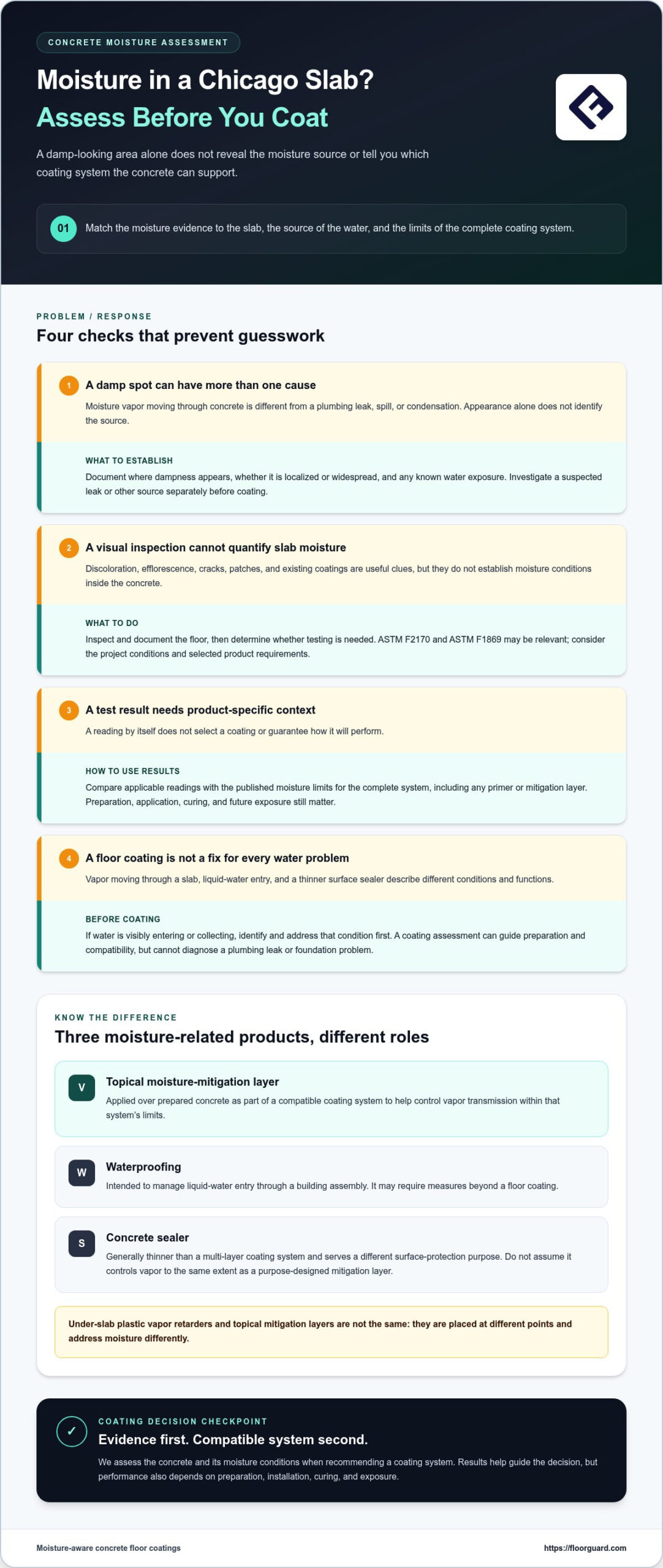
Vapor mitigation limits moisture vapor moving through concrete as part of a compatible coating system. Waterproofing is intended to manage liquid-water entry. Neither term guarantees that a coated floor will resist every moisture source.
How moisture vapor can affect a concrete coating
When moisture moves through a slab, it may challenge the bond between the concrete and coating. Depending on the conditions, coating defects can include bubbles, blisters, or areas that lose adhesion. These outcomes aren’t inevitable. They depend on the slab, preparation, product limits, installation quality, and exposure. A moisture-mitigating layer can help address vapor within the limits of its system, but it isn’t a universal add-on for every basement floor.
Before selecting a coating, consider visible dampness alongside the slab’s condition and moisture test results. For example, a localized wet patch near a pipe may point to a leak that needs investigation, rather than a need for a vapor-control product. Treating the wrong source can leave the underlying issue unresolved and put the coating at risk.
Moisture mitigation versus waterproofing and concrete sealer
These terms describe different functions. A moisture-mitigating primer or layer is designed to control vapor transmission through concrete while supporting a compatible coating system. Waterproofing addresses liquid-water entry through a building assembly, which may require measures beyond a floor coating. A concrete sealer is generally thinner than a multi-layer coating system and serves a different surface-protection purpose. Don’t assume it controls vapor to the same extent as a purpose-designed mitigation layer.
No coating system should be treated as a fix for an active plumbing leak, ongoing water intrusion, or a foundation problem. If water is visibly entering or collecting, identify and address that condition before planning a floor coating—such as by consulting structural damp-proofing specialists like HYPERSEC to diagnose and resolve persistent moisture issues. We consider the slab and its moisture conditions when recommending a coating system, while recognizing that coating assessment and preparation can’t resolve every water problem. A moisture vapor barrier for concrete floors Chicago homeowners consider should suit the tested slab and the complete coating system, not just the floor’s appearance.
How Chicago Slab Moisture Is Evaluated Before Coating
A sound coating recommendation starts with evidence, not assumptions based on a damp spot or the city where a property is located. We evaluate the concrete, note signs of moisture, select suitable testing, and compare the findings with the limits of the proposed coating system. This helps distinguish slab conditions that may affect coating selection from a leak or another source that needs separate attention.
What a concrete moisture assessment should establish
Start by inspecting and documenting the floor. Record visible dampness, discoloration, efflorescence, existing coatings or patches, cracks, and the slab’s general condition. Note known water exposure, such as a past spill or plumbing issue, and whether moisture appears in one location or across a broader area. These observations help guide the assessment, but they don’t establish the cause on their own.
A visual check can identify clues, but it can’t quantify moisture conditions inside the concrete. Testing may be needed to determine whether moisture levels are suitable for a particular coating system. Methods such as ASTM F2170 and ASTM F1869 may come up during planning. Review their use, current procedures, and relevance in light of the project conditions and selected product requirements. The Association for Materials Protection and Performance discusses concrete moisture testing and mitigation methods and options.
A coating assessment has limits. It can inform decisions about preparation and coating compatibility, but it doesn’t diagnose a plumbing leak or determine whether a foundation has a structural problem. If signs suggest that water is entering from a specific source, evaluate that issue separately before coating work proceeds.
How moisture test results guide coating selection
Testing is useful only when results are interpreted in context. Compare the applicable readings with the published moisture limits for the complete coating system, including any primer or mitigation layer under consideration. A result within a product’s stated limits can help inform selection, but it doesn’t guarantee performance. Preparation, application, curing, and future exposure still matter.
For example, two sections of a basement may have different conditions, or an older coating may need additional evaluation before testing can guide a new system. Depending on the inspection and initial results, the next step may be further testing, retesting, or a change in system selection. There is no single test plan that fits every Chicago basement.
We use slab conditions and relevant moisture findings to guide coating recommendations, rather than assuming every floor needs the same barrier. If you’re planning a basement coating and want help assessing the concrete, discuss your floor assessment with our team.
Comparing Moisture-Mitigation Primers and Coating-System Options
A primer’s name alone doesn’t tell you whether it can manage moisture. A standard primer is generally selected to support adhesion between prepared concrete and the coating layers above it. A moisture-mitigating primer has a different role: it’s designed to control vapor transmission within the limits of its product system. Other options may include a compatible mitigation layer, primer, basecoat, and topcoat selected together. None is a universal fix for every slab condition.
Start with the concrete and the basement’s intended use. Use this comparison as a guide, not as a product specification. Actual suitability depends on assessment results and the products’ published requirements.
| Substrate condition | Moisture evidence | System compatibility | Project considerations |
|---|---|---|---|
| Sound, prepared concrete | Findings are within the selected coating system’s stated limits | A standard primer may be suitable if the system calls for one | Consider intended use, desired finish, traffic, and curing schedule |
| Concrete with moisture conditions requiring mitigation | Assessment indicates the slab exceeds or may exceed the ordinary system’s limits | Use a moisture-mitigating primer only with compatible basecoat and topcoat layers | Confirm preparation requirements, product limits, and installation sequence |
| Concrete with active water intrusion or unresolved damage | Visible water or conditions suggest a source beyond vapor transmission | Do not assume a coating or primer can resolve the underlying issue | Address the water source or other concern before planning the coating |
| Previously coated, patched, or variable concrete | Conditions may differ across the floor or be affected by existing materials | System selection depends on the assessed surface and product requirements | Allow for additional preparation or evaluation if needed |
When a moisture-mitigating primer may be considered
Consider one when the assessment indicates that moisture control is needed for the proposed coating system. It must work with the basecoat and topcoat as a complete system. Combining products simply because each is labeled for concrete can create compatibility or bonding problems. A primer also won’t repair an active leak, correct a foundation issue, or make every high-moisture slab suitable for coating.
Choosing a compatible epoxy, polyurea, or polyaspartic system
Moisture is only one selection factor. Epoxy is a resin-based coating often chosen when its application and curing requirements fit the project. Polyurea is known for flexibility, adhesion, impact resistance, and fast curing. Polyaspartic is a type of polyurea often used where UV stability is important, including as a topcoat.
For a basement with limited direct sun, priorities may differ from those for a floor exposed to sunlight, heavier traffic, or chemicals. Appearance, project timeline, and budget matter too. No material is best for every floor. The right choice depends on slab condition, exposure, intended use, and product limits. For a moisture vapor barrier for concrete floors Chicago basements, we match the primer and coating layers to the assessed floor rather than choosing by material name alone. Results also depend on preparation, product selection, installation quality, use, and maintenance.
Planning Moisture Mitigation for a Chicago Concrete Floor
Plan for the floor you have, not an assumed “Chicago slab.” Conditions can vary from one property to another, even within the same building. A basement used as living or storage space has different demands from a garage exposed to vehicle traffic. An occupied commercial area may require careful coordination around access and downtime. The moisture vapor barrier for concrete floors Chicago property owners consider should match the assessed slab, the coating system, and how the space will be used.
Project conditions that can change the coating plan
Before selecting materials, consider the floor’s history and expected exposure. Past water events, existing coatings, patches, cracks, and visible moisture can influence preparation and system choices. So can routine use: foot traffic, stored items, vehicles, cleaning products, or direct sunlight near windows. These details connect assessment findings to a practical coating recommendation. The city name alone can’t tell you what the slab needs.
We consider these project factors alongside the intended finish and concrete condition. Homeowners planning a basement upgrade can explore our basement and residential floor coating services while thinking through how the room will be used. A coating plan should account for the actual floor, not rely on a standard recipe for every property.
Installation stages and return-to-service expectations
Moisture mitigation is only one part of a coating project. Each stage prepares the floor for the next, and the scope can change based on slab condition, repairs, selected products, and site requirements.
- Inspect and assess: Review the slab, existing coatings, visible signs, and relevant moisture findings to inform system selection.
- Prepare the surface: Complete crack or pit repairs that affect coating preparation, then use mechanical preparation, usually diamond grinding, to create a suitable surface. Remove dust and contaminants before application.
- Apply compatible layers: Install the specified primer or moisture-mitigation layer, followed by the compatible basecoat. Add decorative flakes or pigments if selected, then apply the protective topcoat.
- Allow proper curing: Follow the system’s curing requirements before returning the floor to use.
Installation time and cure time are not the same. A project may take longer to install if it needs additional evaluation, repairs, or preparation. After application, the floor still needs to cure before people, vehicles, or stored items can return. Return-to-service timing depends on the products and project conditions, so plan around the specific system rather than assuming a fixed schedule.
Our recommendations connect slab assessment, preparation, coating layers, and intended use. Request a concrete floor coating assessment to discuss your basement or another floor with our team.
How Floorguard Approaches Moisture-Aware Concrete Floor Coatings
A coating recommendation should fit the floor, not just the material a homeowner has in mind. At Floorguard, we assess the concrete and relevant moisture conditions before recommending a system. This helps us consider whether the proposed layers are compatible with the slab and the room’s intended use. Moisture assessment and preparation are important parts of coating work, but they don’t guarantee protection against every water problem.
What our team considers before recommending a system
We look at the slab’s condition and moisture findings alongside the project’s practical needs. A basement used for storage may have different priorities from a finished living space. A commercial floor may need to accommodate regular foot traffic, cleaning, or other demands while the project is planned around facility operations.
Our recommendation may also account for existing coatings or patches, expected sunlight, appearance preferences, installation timeline, and budget. Epoxy, polyurea, and polyaspartic each have distinct properties, so we don’t treat one material as the answer for every floor. Instead, we match a compatible system and preparation plan to the project.
For businesses considering a floor upgrade, our commercial concrete coating services are planned with the space’s use and project needs in mind.
Preparation is central to that plan. Depending on the floor, coating work may include inspection, moisture checks, repairs to cracks or pits that affect the coating, diamond grinding, and dust removal. Compatible primer and coating layers follow. The exact materials and steps vary with the concrete and selected system.
Next steps for a Chicago coating project
Help us understand the project by sharing a few basics: whether the floor is a basement, garage, or commercial space; how you plan to use it; any visible moisture or past water events; the condition of existing coatings; and your goals for appearance and timing. These details give our team a useful starting point for discussing assessment and coating options.
A floor assessment is a practical way to discuss the slab and next steps. It helps inform a coating recommendation, but it shouldn’t be mistaken for a promise that a coating will stop every source of moisture or prevent every future issue. System performance depends on suitable preparation, product selection, installation, use, exposure, and maintenance.
If you’re planning a basement coating or another Chicago concrete floor project, contact our team about your floor coating project. We’ll discuss the floor’s condition, intended use, and coating goals so the recommendation is grounded in the project itself.
Make Your Next Coating Decision With Confidence
The right next step is to turn uncertainty about the floor into a clear project plan. Before deciding on a moisture vapor barrier for concrete floors Chicago, note where moisture appears, what you know about the slab’s history, and how you want to use the space. Those details help focus an assessment on the floor and the coating system it needs.
Our team can discuss suitable coating options for your concrete and explain how preparation and system compatibility shape the recommendation. The goal is an informed choice, not a promise that any coating can prevent every moisture issue.
Contact Floorguard to discuss a Chicago concrete floor coating assessment and take the next step toward a coating plan tailored to your space.
Frequently Asked Questions
Is a moisture vapor barrier necessary before coating a concrete floor?
Not always. Whether a moisture-mitigating layer is needed depends on the slab’s condition, moisture assessment, and the selected coating system’s requirements. For a Chicago basement, a floor with results within the system’s stated limits may not need a separate mitigation layer. Don’t decide based only on a damp-looking spot or assume every concrete floor needs the same primer. Base the plan on the floor and product requirements.
Can you coat concrete that has high moisture readings?
Sometimes, but only if the assessment supports a compatible system designed for the measured conditions. Compare the applicable test results with each system component’s published limits, including any mitigation layer, primer, and coating. A high reading doesn’t automatically mean the floor can’t be coated, but it may narrow the suitable options. If readings vary across the basement, additional evaluation may help guide the recommendation.
Does a moisture vapor barrier stop water from leaking into a basement?
No. A moisture-mitigating layer in a floor coating system is intended to address vapor transmission through concrete within product limits, not fix an active plumbing leak or every route for liquid water. For example, water appearing after rain or near a pipe may have a different source than moisture moving through the slab. Identify and address active water entry separately before planning a coating installation.
What is the difference between a moisture vapor barrier and a concrete sealer?
A moisture-mitigating layer is selected to help control vapor transmission as part of a compatible coating system. A concrete sealer is generally thinner and serves a different surface-protection purpose. For a Chicago basement, choosing a sealer based only on the word “protective” may not address the coating system’s moisture requirements. Check the intended function and product compatibility rather than treating these materials as interchangeable.
Can a moisture barrier be applied over an existing floor coating?
It depends on the existing coating’s condition and whether the proposed system is compatible with it. Peeling, contamination, unknown coatings, or patchy repairs can affect adhesion and may require additional assessment or preparation. Don’t assume a new moisture-mitigating layer can simply go over any finished surface. Evaluate the existing coating and concrete, then follow the selected system’s preparation instructions.
How long does a concrete floor take to dry before coating?
There isn’t one drying period that applies to every slab. Concrete may look dry at the surface while moisture conditions inside it still matter to coating selection. The schedule depends on the slab, site conditions, test findings, and the chosen products’ requirements. Rather than relying on appearance or a fixed number of days, use an appropriate moisture assessment and follow the coating system’s installation guidance.
Can a moisture vapor barrier make a concrete floor completely waterproof?
No. A moisture-mitigation layer may help manage vapor within its intended use and product limits, but it doesn’t make a concrete floor completely waterproof or protect against every source of water. Performance depends on the slab, system compatibility, preparation, installation, and exposure. For a Chicago basement with visible water entry, address that concern separately instead of relying on a floor coating to stop it.


