
Why do some Chicago garage floors look pristine after a decade while others begin to peel and delaminate after just a few seasons? The secret to a long-lasting finish isn’t just the quality of the initial diamond grinding; it’s the specific maintenance strategy used to combat our city’s extreme humidity and winter road salt. You’ve likely felt the frustration of wondering if a certain cleaner will dull your shine or if the moisture in your basement is slowly undermining your investment. It’s a common concern for homeowners and facility managers alike who want to protect their property from the ground up.
We believe your floor should be a reliable, worry-free foundation for your home or business. Learning how to extend floor coating lifespan requires moving beyond generic cleaning to a technical protocol tailored for professional epoxy, polyurea, and polyaspartic systems. This guide provides the clear cleaning schedules and environmental strategies you need to maximize durability for decades. We’ll examine which chemicals to avoid, how to manage Chicago’s unique climate shifts, and the specific indicators that tell you when a professional recoating is necessary to maintain your floor’s integrity. By following these professional standards, you can ensure your surface remains as durable as the day it was installed.
Key Takeaways
- Professional polyurea and polyaspartic systems can last decades, but their actual service life depends on distinguishing between surface wear and structural integrity.
- Mechanical bonding through professional diamond grinding is the essential foundation for a coating that won’t peel, offering far better results than DIY acid etching.
- Mastering how to extend floor coating lifespan involves a specific cleaning cadence and avoiding harsh chemicals that can degrade the topcoat’s molecular bonds.
- Protecting your floors from Chicago’s humidity and summer hot tire pick-up requires targeted environmental shielding strategies to prevent aesthetic issues like ambering.
- Identifying the difference between a simple surface stain and moisture migration helps you decide when to seek a professional assessment before damage spreads.
Coating Chemistry and Environment: What Determines Floor Longevity?
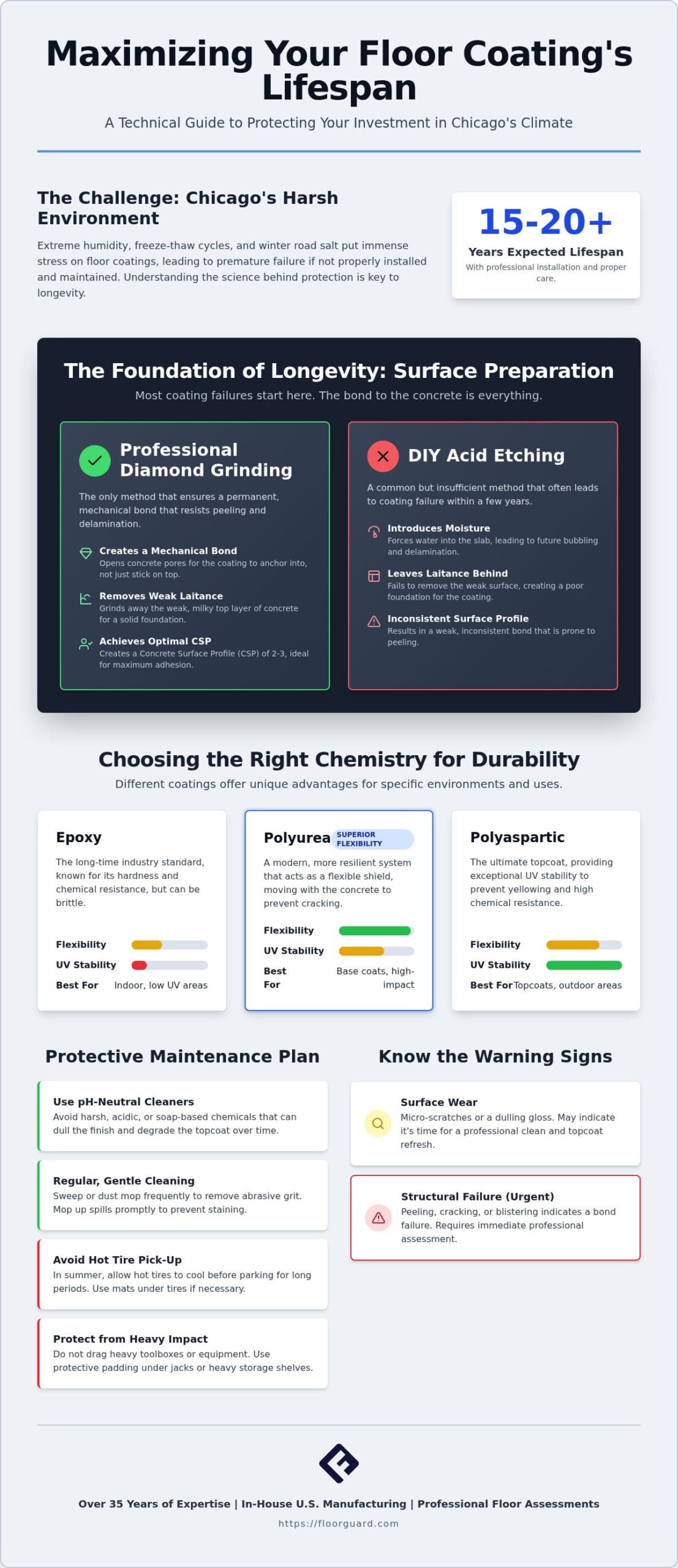
Professional-grade concrete coatings aren’t just a surface treatment; they’re a long-term investment in your property’s infrastructure. When properly installed, these systems boast an expected lifespan of 15 to 20 years or more. However, it’s vital to distinguish between “service life” and aesthetic longevity. Service life refers to the coating’s ability to protect the underlying concrete from moisture and chemicals. Aesthetic longevity is about maintaining that showroom gloss. In Chicago, our extreme humidity and brutal freeze-thaw cycles put immense stress on floor bonds. As the concrete expands and contracts, a rigid coating can snap. This is why understanding how to extend floor coating lifespan starts with choosing the right chemistry for our local climate. Understanding the science behind different flooring materials is the first step toward a successful project.
Many homeowners are tempted by DIY epoxy kits found at big-box stores, but these often fail within two years because they lack the solids content and bond strength of industrial systems. Unlike those thin, water-based paints, professional residential floor coatings are engineered to penetrate the concrete pores. This creates a mechanical bond that resists the delamination caused by Chicago’s high water table and seasonal temperature swings.
Epoxy vs. Polyurea vs. Polyaspartic Durability
Epoxy has been the industry standard for decades, but it’s naturally brittle. If your foundation shifts slightly or experiences thermal shock, epoxy may crack. Polyurea offers superior flexibility, acting as a resilient shield that stretches with the substrate. For areas with high sun exposure, such as garage aprons or shop floors, polyaspartic topcoats are essential. They provide high UV stability, preventing the “ambering” or yellowing common in standard epoxies. These systems also carry higher chemical resistance ratings, protecting your slab against road salt, motor oil, and gasoline.
The Impact of Traffic and Load Cycles
Your floor’s durability is tested every time you park a vehicle or slide a heavy toolbox. Differentiating between foot traffic and vehicular load is key to managing wear. Heavy machinery or static point-loading from tall storage shelves can compress a coating over time, which is why optimizing layout planning and wall-hung organization—such as the setups featured on thegaragerx.com—helps reduce direct strain on the slab. We often recommend decorative flake systems because they serve a dual purpose. Beyond the visual appeal, the multi-layered flake texture helps hide micro-abrasions and scratches that naturally occur in high-traffic zones. This keeps the floor looking newer for longer while maintaining its structural grip and slip-resistant properties.
Surface Preparation: Why Diamond Grinding is the Key to Lifespan
Most coating failures don’t start with the topcoat. They start at the interface where the resin meets the concrete. If you want to know how to extend floor coating lifespan, look at the preparation phase. While some contractors still rely on acid etching, this method is often insufficient for long-term adhesion. Acid etching uses a chemical reaction to roughen the surface, but it fails to remove laitance, the weak, milky layer of cement that rises to the top during pouring. It also introduces unwanted moisture into the slab, which can lead to future delamination or bubbling as that water tries to escape.
The Diamond Grinding Process Explained
Our process uses industrial-grade grinders equipped with diamond-segmented blades. These machines strip away contaminants, old sealers, and that weak laitance layer to open the concrete’s pores. To keep your home or facility clean, we use vacuum-contained systems that capture 99.9% of the dust at the source. By grinding the surface, the coating becomes an integral part of the concrete slab rather than just a layer sitting on top. If you have questions about your specific slab condition, you can request a professional floor assessment to see which preparation method is right for you.
Curing Timelines: Installation vs. Full Service
Patience is a critical part of durability. There’s a big difference between a floor that’s dry to touch and one that’s chemically cured. While you might be able to walk on a polyaspartic floor in 6 to 24 hours, driving on it too soon is a recipe for disaster. Premature vehicular traffic causes hot-tire pick-up, where the heat from your tires pulls the partially cured coating right off the concrete. Standard epoxy systems can take up to 7 days to fully cure, whereas polyaspartic systems often reach full strength in much less time. Always follow the specific return-to-service schedule provided by your installer to protect your investment for the long haul.
Routine Maintenance: Best Practices for Cleaning High-Performance Floors
While professional systems are incredibly durable, the term “maintenance-free” is a common industry myth. These surfaces are actually “low-maintenance,” meaning they require minimal but specific care to stay functional for decades. If you ignore routine cleaning, abrasive particles like sand or winter road salt act like sandpaper under foot traffic. Over time, this friction wears down the topcoat, dulling the finish and compromising the protective seal. Understanding how to extend floor coating lifespan means committing to a simple, consistent maintenance cadence that prevents this mechanical wear before it starts. In Chicago, where winter salt is tracked in daily, this consistency is your floor’s primary line of defense.
Establish a schedule that matches your floor’s usage. For high-traffic garages or commercial spaces, a daily sweep with a soft-bristle broom is essential to remove grit. On a weekly basis, a damp mop with clean water and a proper cleaning agent will remove the finer dust that sweeping misses. This routine protects the slip-resistant texture built into your decorative flake or solid-color system. If debris is allowed to fill the microscopic “valleys” of the floor’s texture, the surface becomes slick and unsafe, defeating the purpose of a high-performance finish.
The Professional Cleaning Toolkit
Toss out the traditional string mop. These old-fashioned tools are inefficient; they mostly move dirty water around and leave behind cotton fibers that get trapped in the floor’s texture. Instead, use a microfiber mop. Microfiber lifts and traps dirt far more effectively than cotton. For sweeping, always choose a soft-bristle broom. Stiff, plastic bristles can create microscopic scratches that eventually harbor bacteria and grime. For large commercial floor coatings, a foam squeegee is an invaluable tool. It allows you to move large volumes of water toward drains quickly, ensuring the surface dries without streaks or water spots.
Chemical Safety: What to Use and What to Avoid
The chemistry of your floor is sensitive to extreme pH levels. Many homeowners mistakenly use vinegar or citrus-based cleaners, thinking they’re safe because they’re “natural.” In reality, these acids can slowly etch the resin, leading to a cloudy, permanent haze. Bleach is equally dangerous; it can cause certain resins to become brittle and prone to cracking over time. Always use a pH-neutral cleaner specifically formulated for resinous floors. Avoid standard dish soaps or oil-based cleaners at all costs. These products leave a microscopic film that attracts more dirt and makes the floor dangerously slippery when wet. Using the right chemistry is the most direct way to master how to extend floor coating lifespan without risking accidental damage.
Environmental Shielding: Protecting Coatings from UV, Chemicals, and Impact
Learning how to extend floor coating lifespan involves more than just a mop; it requires a proactive shield against environmental stressors. In Chicago, your floor faces a unique gauntlet of challenges, from intense summer UV radiation to the corrosive road salt tracked in during the winter. While the chemical bond created during installation is strong, external forces like thermal shock and chemical spills can slowly degrade that integrity. Protecting your investment means understanding these threats and implementing specific protocols to mitigate them before they cause permanent damage.
Spill response is your first line of defense. While professional resins are highly chemical-resistant, they are not invincible. Battery acid, motor oil, and de-icing chemicals should be neutralized and removed immediately. If left to sit, these substances can cause localized softening or staining of the topcoat. In a commercial floor coating environment, we recommend placing high-quality walk-off mats at every entrance. these mats capture up to 80% of the grit and moisture that would otherwise act as an abrasive on your high-performance surface. This simple addition significantly reduces the mechanical wear on your topcoat in high-traffic zones.
UV Stability and Topcoat Integrity
UV radiation is the primary cause of “ambering,” a yellowing effect that occurs when epoxy molecular bonds break down. This happens because standard epoxies use aromatic chemistries that react to sunlight. For any area with windows or garage doors that stay open, a polyaspartic topcoat is a non-negotiable requirement. Polyaspartic systems use aliphatic chemistry, which remains stable and clear even under direct sun exposure. If you notice your floor looks chalky or has lost its original depth of color, your topcoat may be thinning. This is a clear signal that it’s time for a professional refresh to prevent the sun from reaching the base layers. If you’re seeing these signs, contact us for a floor assessment to determine if a new topcoat can restore your system’s protection.
Mechanical Protection Strategies
Physical impact and heat are the final pieces of the durability puzzle. If you perform welding or heavy grinding in your workspace, always use welding blankets or heat-resistant pads. Sudden localized heat can cause thermal shock, leading to “pop-outs” where the coating loses its bond with the concrete. Similarly, heavy stationary machinery can cause vibration wear, which slowly grinds the coating against the slab. We also advise a strict “no-drag” policy for heavy metal objects. Even the toughest polyurea system can be gouged by the sharp edge of a steel cabinet or engine block. Always use dollies with non-marring rubber wheels to move heavy equipment across your coated surface. These small habit shifts are essential for anyone serious about how to extend floor coating lifespan in a demanding environment.
Professional Assessments: When to Call Floorguard for a Refresh
Even the most diligent maintenance routine eventually reaches its limit. While you’ve learned how to extend floor coating lifespan through proper cleaning and environmental shielding, recognizing when to call in an expert is the final step in protecting your concrete. There is a significant difference between surface staining and structural failure. A stain might just be a stubborn mark from a spill; however, structural failure, such as delamination or bubbling, indicates that the bond between the resin and the slab has been compromised. Identifying these issues early prevents small problems from turning into full-scale floor replacements.
Localized crack repair is another vital service to maintain your floor’s integrity. If a crack develops in your slab, it creates a pathway for moisture migration. In Chicago, water can seep under the coating and freeze, forcing the layers apart and causing the finish to peel. We also offer a “Screen and Recoat” process for floors that are structurally sound but aesthetically worn. This involves lightly abrading the existing topcoat and applying a fresh layer of polyaspartic resin. It’s an efficient way to restore the original gloss and slip resistance without the cost or downtime of a complete removal.
Signs Your Floor Needs Professional Attention
Blistering is a common indicator of hydrostatic pressure. This occurs when water vapor pushes up from beneath the slab, creating small bubbles in the coating that eventually burst. If you notice a persistent loss of gloss, your protective topcoat has likely thinned to a critical level. You can test your slip-resistance aggregate by feeling the surface when it’s wet. If the floor feels smooth rather than textured, the aggregate has worn away. This creates a safety hazard that requires a professional refresh to restore grip.
The Floorguard Advantage: US-Manufactured Longevity
We bring over 35 years of industry experience to every project. As a family-owned company with in-house U.S. manufacturing, we understand exactly how our materials react to the local environment. Professional-grade resins outlast big-box store alternatives because they are engineered for maximum bond strength and UV stability. We invite you to leverage our legacy by requesting a comprehensive floor audit for your Chicago area property. Our team will assess your current system and provide a clear recommendation on how to extend floor coating lifespan for the next several decades. Contact Floorguard today for a professional floor assessment, recommendation, or free estimate to ensure your investment remains protected.
Protect Your Chicago Flooring Investment for Decades
Maximizing the life of your concrete surface requires a proactive approach that starts with professional installation and continues with disciplined care. By prioritizing diamond-grinding preparation and adhering to a pH-neutral cleaning schedule, you’ve already taken the most important steps in learning how to extend floor coating lifespan. These strategies don’t just keep your floor looking new. They protect the underlying slab from the moisture and salt that define our local climate. Even the most durable polyurea or epoxy system benefits from a professional audit to catch minor wear before it leads to structural failure. For property owners also planning wider exterior improvements alongside garage renovations, you can explore Project-based artificial turf design and installation fees to budget for complementary low-maintenance ground surfacing.
Floorguard brings over 35 years of industry-leading experience and the reliability of US-based manufacturing to every project. We understand the specific technical needs of Chicago properties. We provide the specialized diamond-grinding process required for a permanent bond. Contact Floorguard today for a professional floor assessment and free estimate. Our team’s ready to help you ensure your garage, basement, or commercial facility remains a beautiful, high-performance foundation for years to come.
Frequently Asked Questions
How many years does a professional epoxy or polyaspartic floor coating typically last?
A professional system installed with proper diamond grinding typically lasts 15 to 20 years in a residential setting. Systems backed by US-based manufacturing are engineered to handle Chicago’s temperature swings better than thin DIY kits, which often fail within two years. Your floor’s actual lifespan depends on the volume of vehicular traffic and how consistently you follow a maintenance routine.
Can I use a pressure washer to clean my coated garage floor?
Yes, you can use a pressure washer, but you should keep the pressure below 1,500 PSI to avoid damaging the topcoat. Use a wide fan tip and maintain a distance of at least 12 inches from the floor surface. Never aim the high-pressure stream directly at expansion joints or existing chips, as this can force water under the resin and cause the coating to lift.
What is the best cleaner for a polyurea or epoxy floor coating?
The best cleaner is a pH-neutral solution mixed with clean water. Choosing the right chemistry is a fundamental part of how to extend floor coating lifespan because it prevents the hazing caused by acidic cleaners like vinegar. Avoid using dish soaps or oil-based cleaners, as these leave a microscopic film that attracts dirt and makes the surface dangerously slippery.
Why is my garage floor coating turning yellow or chalky?
Yellowing, also known as ambering, occurs when UV radiation breaks down the molecular bonds in standard aromatic epoxy resins. If the surface looks chalky, the topcoat is likely eroding due to sun exposure or harsh chemical cleaners. To prevent this in sun-drenched areas, we recommend an aliphatic polyaspartic topcoat, which is naturally UV-stable and maintains its clarity for decades.
Do I need to wax or buff my floor coating to keep it shiny?
No, you should never wax or buff a professional resinous floor coating. These systems are non-porous and designed to maintain their gloss without additional topical treatments. Wax actually creates a maintenance problem by trapping dirt and requiring frequent stripping. A simple microfiber mop and a pH-neutral cleaner are all that’s required to keep the finish looking like new.
How do I repair a chip or scratch in my floor coating?
Small chips should be cleaned with denatured alcohol and filled with a matching resin touch-up kit to prevent moisture migration. Sanding the edges of the chip helps the new material bond securely to the existing system. For deep gouges that reach the concrete, it’s best to call for a professional audit to ensure the slab’s integrity hasn’t been compromised.
Is road salt from Chicago winters dangerous for my floor coating?
Road salt isn’t immediately corrosive to professional resins, but it acts as a heavy abrasive that can dull the topcoat’s finish. During Chicago winters, salt deposits should be rinsed away weekly to prevent them from grinding into the surface under tire traffic. Consistent rinsing is a simple but effective strategy for how to extend floor coating lifespan during our harshest months.
How long should I wait before driving on a newly installed floor coating?
You should generally wait 24 to 48 hours for polyaspartic systems and up to 7 days for traditional epoxy before driving a vehicle onto the surface. Although the floor may be “dry to the touch” within hours, the chemical curing process takes longer to reach full shore hardness. Driving too early can result in hot tire pick-up, where the coating permanently delaminates from the concrete.


