
At Floorguard, we know the fastest-curing floor is not automatically the right floor for your facility. Commercial polyurea flooring can suit demanding spaces, but the right choice depends on the concrete, conditions in the building, and how the floor will be used.
It makes sense to weigh installation speed against disruption to daily operations. But cure time is only part of the schedule, and epoxy, polyurea, and polyaspartic systems differ in performance and application. Choosing by coating name alone won’t tell you whether a system fits your needs.
In this guide, we explain how to compare these coating options and what a thorough assessment should cover, from concrete condition and moisture testing to surface preparation and installation. We also explain what to ask about cure time versus return-to-service timing, so you can plan around operations and evaluate whether the proposed system suits your facility in Chicago.
Key Takeaways
- Commercial polyurea flooring should be selected for the facility’s concrete, conditions, and daily demands, not by coating name alone.
- Ask how the installer will assess and mechanically prepare the concrete, and what site conditions could change the installation sequence.
- Compare polyurea, epoxy, and polyaspartic as complete systems, including their intended roles, curing behavior, and suitability for UV exposure.
- Before requesting an assessment, document traffic, chemical exposure, moisture concerns, cleaning needs, sunlight, operating hours, and acceptable downtime.
- Evaluate installers by how clearly they explain materials, preparation, and project-specific planning, including how installation, curing, and return to service differ.
What Is Commercial Polyurea Flooring, and When Does It Fit?
Commercial polyurea flooring is a concrete coating system made with polyurea-based material. Applied over prepared concrete, it can form a protective surface for work areas, facilities, and customer-facing spaces. Depending on the system selected, it may help floors withstand abrasion, impacts, and some chemical exposure while making routine cleaning easier.
These are potential benefits, not guarantees. Performance depends on the concrete’s condition, preparation, product selection, installation quality, exposure, and maintenance. A floor exposed to rolling equipment, spills, or frequent foot traffic has different demands from one used mainly for light activity. Assess the site and its work routines before deciding whether a coating is suitable.
How does polyurea differ from epoxy and polyaspartic?
Epoxy is a resin-based coating, not another name for polyurea. Polyurea is known for flexibility, adhesion, fast curing, and impact resistance, but actual results depend on the specific system and its installation. Polyurea offers a technical overview of the material’s chemistry and development. Polyaspartic is a type of polyurea often chosen for UV stability or used as a topcoat. These materials can play different roles in a system, so compare the complete specification, not just the coating label.
Which commercial environments may benefit from a coating?
Consider a coating where concrete faces regular traffic, abrasion, chemical exposure, or appearance requirements, such as a service area, workspace, or customer-facing floor. Match the system to the actual cleaning routine and operating schedule, too. Ask how the floor’s exposure and desired finish affect product choice and when the space can return to service.
Commercial floors have operating demands that differ from a garage, basement, or patio. Industrial settings may bring heavier traffic or more demanding exposures, so they need their own assessment rather than an automatic extension of a commercial specification. No facility is automatically suitable: existing concrete conditions and site use should guide the recommendation.
How Commercial Polyurea Flooring Is Prepared and Installed
Commercial polyurea flooring installation should follow the conditions of the site, not a fixed recipe. The concrete’s condition, existing coatings, moisture, selected materials, repairs, and number of layers can all affect the work and schedule. A clear proposal should explain each stage and distinguish active installation from curing and the time before the floor can safely return to service.
What should happen before the coating is applied?
The installer should inspect the concrete for damage, contamination, and existing coatings that could affect adhesion. Moisture testing helps identify conditions that may require a different system or additional preparation; for facilities dealing with active seepage or sub-slab intrusion, property managers can learn more about diagnostic leak repair protocols from commercial specialists like Waffen. Cracks and pits may need project-specific repairs as part of coating preparation. This is not the same as structural or foundation repair.
Mechanical preparation, often by diamond grinding, removes surface contaminants and creates a profile the coating can bond to. The crew should then remove grinding dust and other contaminants before application. Ask what preparation is planned and how the installer will confirm the surface is ready.
What does the installation sequence look like?
The exact sequence varies by system, but a facility can use these steps to understand the plan:
- Inspect: Assess concrete condition, existing coatings, and moisture.
- Prepare: Diamond-grind as appropriate, then remove dust and contaminants.
- Address surface defects: Complete any project-dependent crack or pit repairs.
- Apply the system: Install the specified basecoat, followed by optional decorative flakes or pigments and a protective topcoat, if included in the design.
- Cure and verify: Follow the product’s cure requirements before reopening the area for its intended use.
Layer choices depend on the desired finish and facility conditions. Decorative elements affect appearance, while the topcoat is part of the overall protective system. Confirm which materials and layers are included rather than assuming every installation uses the same build.
Plan operational access around the product-specific instructions. Installation time describes the work itself; curing takes place afterward, and safe return-to-service timing may depend on the coating, site conditions, and intended use. Ask when people and equipment can return, whether access can resume in stages, and what reopening restrictions apply. You can learn more about how we approach commercial flooring projects on our commercial flooring contact page.
Polyurea vs. Epoxy and Polyaspartic: Compare the Whole System
A fast cure can help with scheduling, but it doesn’t make polyurea the automatic choice. The right system depends on how the concrete will be used, what it’s exposed to, and the performance and appearance the facility needs. Compare the full coating build and installation plan, not just the material name.
| System or material | Typical characteristics and role | Ask the installer |
|---|---|---|
| Polyurea | Known for flexibility, adhesion, impact resistance, and fast curing. It may be used as a coating layer within a system. | How does this product suit the concrete, moisture conditions, traffic, and chemical exposure? |
| Epoxy | A resin-based coating that may suit projects with particular surface conditions or performance goals. Formulations and system designs vary. | What preparation and layers are specified, and why are they a fit for this facility? |
| Polyaspartic | A type of polyurea often selected for UV stability or used as a topcoat. Its role depends on the complete system. | Is it proposed as a base layer, topcoat, or part of a combination, and how will it perform in the site’s light exposure? |
When might a polyurea-based system make sense?
Flexibility and impact resistance may matter where floors face regular movement, dropped items, or equipment traffic. Strong adhesion still depends on suitable concrete and preparation. In areas exposed to sunlight, ask whether the proposed system includes a polyaspartic layer for UV stability. The Polyurea Development Association offers industry information, but the installer should explain how the specified products address your facility’s actual conditions.
When should another coating system be considered?
Epoxy may be appropriate when its characteristics align with the surface, project goals, and operating plan. Don’t compare a professional multi-layer coating system directly with floor paint or a thinner concrete sealer; they’re different kinds of surface treatments. Ask what each proposed layer does and how the system addresses moisture, sunlight, traffic, chemical exposure, appearance, cleaning routines, installation and cure timing, and budget. That full comparison gives decision-makers a clearer basis for choosing than a claim that one material is always superior.
How to Specify Commercial Polyurea Flooring for Your Facility
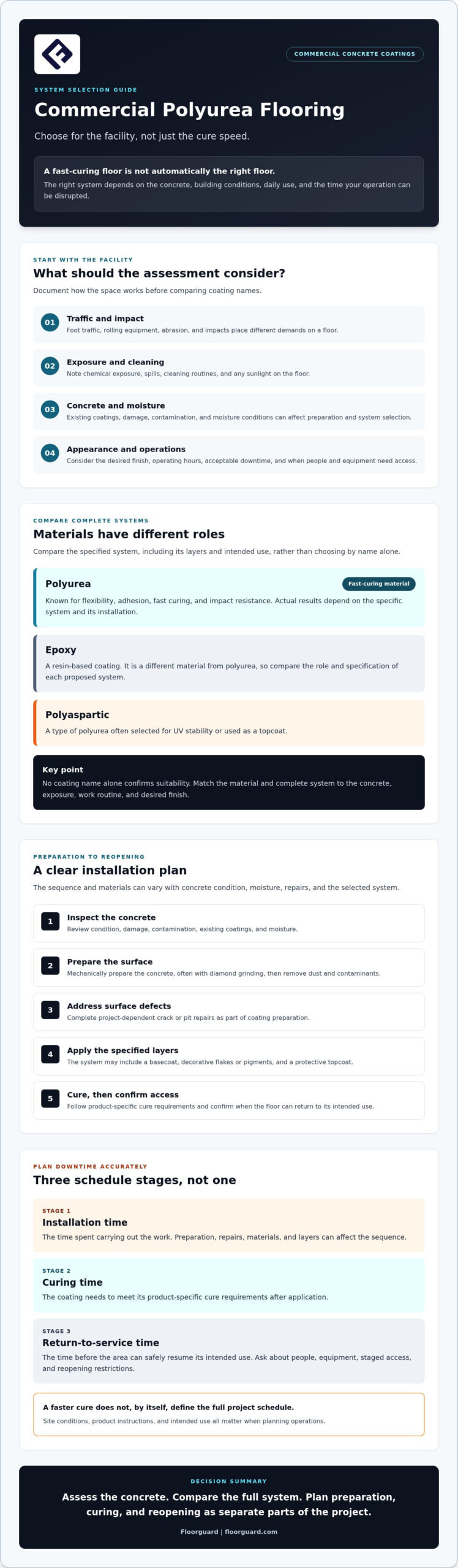
A useful assessment connects the coating proposal to the way your facility actually operates. Before discussing a system, document what the concrete faces and what staff need from the finished floor. This gives the installer a clear basis for recommending commercial polyurea flooring and explaining its limits.
- Concrete: Note visible cracks, pits, worn areas, and any existing coating. Ask how the installer will assess the surface and check for moisture.
- Use and exposure: Describe foot and equipment traffic, likely impacts, chemical spills, and sunlight exposure.
- Daily requirements: Define your preferred appearance, cleaning routine, operating hours, and acceptable downtime.
What should a commercial floor assessment cover?
Ask how existing coatings, surface condition, moisture, cracks, and pits will be evaluated. The proposed plan should identify the mechanical preparation method, coating layers, and why they suit the site. Request clear maintenance instructions and an explanation of performance limitations, including how chemical exposure or heavy traffic could affect the floor over time.
If traction is a concern, ask whether an appropriate additive may improve slip resistance for your conditions. It can help, but no coating or additive eliminates every slipping risk. The installer should explain the finish’s intended use and care considerations rather than promise a completely slip-proof surface.
How can a facility plan around installation and cure time?
Map work zones, access routes, and operational priorities before setting a schedule. If your project includes designated traffic lanes or safety boundaries, check out StripeGuys Warhouse Line Striping to see how industrial striping is coordinated with concrete surfaces. Ask the installer to state the expected installation duration separately from curing time and the point when the floor can return to its intended use. Confirm whether access can resume in stages and what restrictions apply during each cure phase.
For a Chicago, Illinois project, discuss the specific facility, building conditions, and operating schedule with us rather than assuming they will suit a standard plan. Our commercial concrete coating information can provide a starting point for understanding the scope of this type of work. When evaluating your options with us, ask about commercial concrete floor coating installation, the proposed assessment, and how we can plan the work around your facility’s operations.
Choosing a Commercial Polyurea Flooring Installer in Chicago
A reliable proposal should make it clear how we will assess the concrete, prepare the surface, and select the coating system. That detail matters as much as the material name. For a Chicago project, confirm our current service availability and discuss how we can plan the work around your facility’s operating needs.
What questions should you ask before approving a proposal?
Use these questions to see whether the plan is specific to your facility rather than a generic package:
- What will you inspect? Ask how the assessment covers existing coatings, concrete condition, moisture, cracks, and pits, and whether any surface repairs are included.
- How will the surface be prepared? Request the proposed mechanical preparation method and an explanation of why it suits the floor.
- Which layers and finish are specified? Confirm the materials, coating layers, and available finish options, and ask how they address traffic, chemicals, sunlight, and appearance.
- What is the schedule? Get separate expectations for installation duration, curing, and return to service. Clarify any limits on foot traffic, equipment, or cleaning during cure.
- What are the care and coverage terms? Ask for maintenance instructions, known performance limitations, and any applicable warranty terms in writing. Don’t assume a warranty covers every condition or type of wear.
Fast curing alone doesn’t guarantee that a commercial polyurea flooring system fits your concrete or operations. A sound recommendation should connect the inspection findings to the products and preparation proposed, and explain what could affect performance over time.
What should an assessment help clarify?
We offer commercial concrete floor coating installation, including polyurea floor coating installation. An assessment should clarify how the facility’s use, concrete condition, appearance goals, and schedule shape the coating recommendation. We can explain the reasoning behind the proposed preparation and materials, along with any trade-offs or limitations.
Before planning a Chicago-area project, confirm our current service availability and share the facility’s operating requirements with us. We can provide a written scope that identifies the proposed preparation and coating system, then review installation, curing, and reopening expectations with you. Our contact page provides a starting point for discussing a commercial flooring project.
Choose a System That Fits Your Facility
The right commercial polyurea flooring system is the one that matches your concrete, exposure, traffic, and operating schedule. Compare complete systems rather than choosing by material name or cure speed alone. A useful proposal should explain surface preparation, specified layers, maintenance expectations, and the difference between installation time and safe return to service.
A site assessment can turn those priorities into a practical recommendation. We offer commercial concrete floor coating installation, as well as polyurea floor coatings. Ask us which coating options are suitable for your facility and request the proposed scope in writing, including the preparation and project schedule.
Contact Floorguard to discuss your Chicago commercial floor coating project and request an assessment. We can answer questions about the concrete, coating system, and schedule so you can make a decision based on your facility’s needs.
Frequently Asked Questions
What is commercial polyurea flooring?
Commercial polyurea flooring is a concrete coating system that uses polyurea-based material for commercial floor applications. Polyurea is known for fast curing, flexibility, adhesion, and impact resistance, but those characteristics don’t guarantee a particular result. Suitability depends on the concrete, preparation, product selection, traffic, exposure, and maintenance. Have an installer assess the actual floor before recommending a system for your facility.
Is polyurea flooring better than epoxy for commercial spaces?
Polyurea isn’t better than epoxy in every situation. The right choice depends on your project goals and site conditions, including concrete condition, moisture, traffic, chemical exposure, sunlight, desired appearance, timeline, and budget. Ask the installer to explain why the proposed preparation and coating layers fit your facility. A useful recommendation compares complete systems rather than claiming one material is universally best for commercial use.
How long does commercial polyurea flooring take to install and cure?
Installation and curing timelines vary with the floor’s condition, required repairs, chosen materials, coating layers, and site requirements. Installation time isn’t the same as cure time or the point when the facility can safely return to service. Ask for each stage separately and plan access around the project’s written instructions. For Chicago facilities, confirm the schedule for your specific space. Don’t assume every commercial installation takes one day.
Can commercial polyurea flooring be installed over existing concrete coatings?
It depends on the existing coating’s condition and compatibility with the proposed system. Before recommending an approach, the installer should inspect the surface and consider adhesion and contamination concerns. Mechanical preparation or removal may be needed. Don’t assume a new coating can go directly over an old one. Ask what the assessment found, how the surface will be prepared, and why that plan suits the existing concrete.
Does commercial polyurea flooring resist chemicals and abrasion?
Polyurea-based systems may provide chemical and abrasion resistance, but actual performance depends on product selection, preparation, installation quality, exposure, use, and maintenance. A general description of the material isn’t a guarantee against every chemical or traffic condition. Tell the installer which substances may contact the floor and what kind of traffic it handles. Then ask whether the proposed system is intended for those specific exposures and what limitations apply.
Is commercial polyurea flooring slippery when wet?
Slip resistance depends on the coating system, finish, conditions, and any suitable additives. Some additives may improve traction, but no coating eliminates all slipping risks. Explain how the floor is used, cleaned, and exposed to moisture, then ask the installer to discuss finish and texture options and their limitations. Consider both daily operations and cleaning needs before choosing a surface. Don’t treat a traction additive as a guarantee against slips.
How should commercial polyurea flooring be maintained?
Maintain a coated floor according to the manufacturer’s and installer’s care instructions. Cleaning methods should suit the finish and the facility’s exposure, so don’t assume every cleaner or tool is appropriate. Ask how to remove likely contaminants and how chemicals, abrasion, or heavy use could affect the surface over time. Confirm routine care guidance before the project is handed back, and follow it as operating conditions change.


