
The best garage concrete coating for your Chicago home isn’t necessarily the one with the fastest cure or toughest-sounding name. The right choice depends on your concrete’s condition, how you use the garage, and what you expect from the finish. It’s reasonable to compare epoxy, polyurea, and polyaspartic systems while also asking whether the coating will bond well and how long you’ll need to keep vehicles out.
A lasting result starts with the floor, not just the product. When discussing coating options, Floorguard considers the concrete, exposure, traffic, and finish preferences. In Chicago, also consider how road salt, water, and seasonal temperature changes affect what gets tracked into the garage. Careful preparation matters because even a well-chosen system can struggle if the surface isn’t ready for coating.
This article covers five reasons Chicago homeowners consider a garage coating, explains how common systems differ, and outlines what professional preparation and installation can involve. You’ll also learn why installation time isn’t the same as cure time, what to ask about returning your garage to service, and how routine care can help keep the floor looking its best.
Key Takeaways
- A garage concrete coating is a system applied to prepared concrete, with benefits that depend on the floor and how you use the space.
- Compare epoxy, polyurea, and polyaspartic by their properties and intended roles, rather than assuming one option suits every garage.
- Consider how decorative flakes or pigments and a protective topcoat can shape the floor’s appearance and performance.
- Plan for project-specific installation and cure times before moving vehicles or stored items back into the garage.
- Use a practical checklist of moisture, traffic, sun exposure, salt and chemical exposure, finish preferences, schedule, and budget to guide your coating decision.
What Is Garage Concrete Coating, and What Can It Do for Your Floor?
A garage concrete coating is a protective and decorative system applied to properly prepared concrete. Depending on the materials and the floor, it may use a basecoat, decorative flakes or pigments, and a protective topcoat. It isn’t a new floor covering laid over the slab. The goal is to create a finished surface that suits the concrete and the garage’s everyday use.
A professionally selected garage concrete coating can make routine cleaning easier and refresh the floor’s appearance. Depending on the system, it may also be designed to improve resistance to abrasion, impacts, or common garage chemicals. For homeowners who use the garage as a utility hub for plumbing equipment or a whole house water filtration system, a coated slab also creates an easier-to-clean perimeter around home infrastructure. These are potential benefits, not guarantees. Results depend on the concrete’s condition, preparation, product selection, installation quality, exposure, and ongoing care.
How Is a Coating Different from Floor Paint or Concrete Sealer?
Floor paint is not the same as a professional coating system. Paint generally forms a surface film, while a coating system may combine materials in multiple layers to provide a particular finish and performance characteristics. Concrete sealer is generally thinner than a multi-layer coating system and serves a different purpose. Don’t assume paint or sealer will offer the same protection, appearance, or wear characteristics as a coating.
Where Can Garage Coatings Help, and What Should They Not Promise?
A suitable coating can give the garage a more uniform finish and help simplify cleanup of dust and everyday messes. Depending on the system, it can also be selected for resistance to vehicle traffic, abrasion, or chemical spills. In Chicago, consider how water and road salt tracked in on tires may affect your cleaning routine and coating choice. If traction matters, ask whether the system can include suitable slip-resistant additives. They can affect surface texture, but no coating eliminates all slip risk, especially when the floor is wet or contaminated.
A coating won’t correct a structural concrete problem or stop the source of moisture. If a slab has settled, shifted, or shows signs of moisture problems, the underlying condition should be addressed before proceeding. Homeowners can review the American Cement Association’s concrete maintenance and protection guidance for more information about moisture, deterioration, sealers, and protective coatings.
Before recommending a system, our team considers the floor’s condition and intended use. That assessment helps set realistic expectations and identify when the concrete needs attention as part of the coating project.
Epoxy, Polyurea, or Polyaspartic: Which Garage Coating Fits Your Needs?
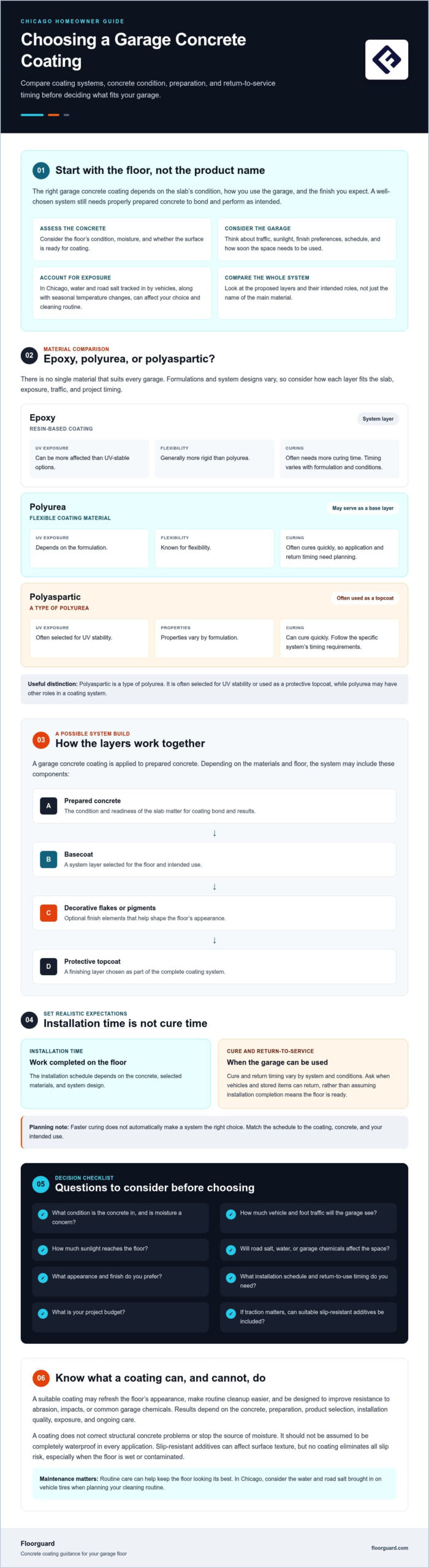
There’s no single coating material that suits every garage. The right garage concrete coating depends on the slab, sun exposure, vehicle and foot traffic, possible chemical spills, desired finish, and how soon you need to use the space again. In a Chicago garage, factor in the water and salt that may come in with vehicles during winter. Compare the complete proposed system, not just the name of its main material. Formulations and system designs vary, so ask how each proposed layer will work for your concrete and intended use.
| Material | UV stability | Flexibility | Curing considerations | Typical system role |
|---|---|---|---|---|
| Epoxy | Can be more affected by UV exposure than UV-stable options | Generally more rigid than polyurea | Often needs more curing time; timing varies by formulation and conditions | Resin-based coating used as a system layer |
| Polyurea | Depends on formulation | Known for flexibility | Often cures quickly, so application and return-to-use timing need careful planning | May be used in a coating system as a base layer or other layer |
| Polyaspartic | Often selected for UV stability | A type of polyurea, with properties that vary by formulation | Can cure quickly; follow the specific system’s timing requirements | Often used as a UV-stable coating or protective topcoat |
When Might an Epoxy Garage Floor System Make Sense?
Epoxy is a resin-based coating, not a generic term for all concrete coatings. Its finish options and intended use may suit some garages, but selection should account for the slab, sunlight, traffic, chemical exposure, and the full coating system. Industry specialists like Drip Epoxy Flooring emphasize evaluating how the specified layers work together, what preparation the concrete needs, and what curing and return-to-service schedule to expect.
How Do Polyurea and Polyaspartic Systems Differ?
Polyurea is known for fast curing, flexibility, adhesion, and impact resistance, though exact performance depends on formulation and installation. Polyaspartic is a type of polyurea often chosen when UV stability matters or used as a topcoat. Fast curing may shorten the application window, so preparation and scheduling need coordination. Cure time and when the garage can be used again aren’t automatically the same.
Floorguard offers residential concrete floor coating installation. Ask how the proposed layers fit your garage and what to expect during installation and curing. Contact our team to discuss your garage floor.
Why Garage Concrete Coating Preparation Determines the Result
Preparation is not a cosmetic step. It helps create the surface conditions a coating needs to bond, and it can reveal issues that affect product choice, repairs, and project timing. Applying a coating over poorly prepared concrete, residue, or an incompatible existing finish can compromise adhesion and performance.
Before selecting a garage concrete coating, assess the slab’s condition, moisture, existing coatings, damage, contaminants, intended use, and the preparation and repair work needed. AMPP explains that proper concrete surface preparation is important for coating adhesion and that factors such as existing coatings, contamination, damage, defects, and moisture should be evaluated before a coating is applied.
What Does a Professional Garage Floor Inspection Check?
An assessment looks at the concrete and its history, not just its appearance. The team may check for existing paint or coating, visible cracks and pits, surface contamination, and signs that moisture needs further evaluation. Unknown or failing layers matter because the new system must be compatible with the substrate and any material that remains.
Moisture testing can help inform preparation and product selection, but there is no single result that automatically determines suitability for every coating. The test method, findings, concrete condition, and product requirements all matter. Cracks and pits should also be assessed to determine whether coating-project repairs are appropriate before the system is applied.
Why Is Diamond Grinding Used Before Coating Concrete?
Mechanical preparation, usually diamond grinding, helps create a suitable concrete surface for the selected coating. It can remove weak surface material and residues while opening the surface profile for coating adhesion. The exact preparation method depends on the slab, any existing finish, and the coating system being considered.
After grinding, dust and other contaminants must be removed before coating layers go down. Skipping this cleanup can leave material between the concrete and coating. Repairs, preparation methods, and the amount of work required vary by project, so discuss a visible crack, old coating, or moisture concern during assessment rather than covering it without evaluation.
What Happens During Garage Coating Installation, Curing, and Maintenance?
A garage coating project typically moves from surface preparation to coating application, then curing. The exact sequence, materials, number of layers, repair needs, and installation time depend on the concrete and selected system. A clear plan should explain both the work schedule and when you can safely use the floor again.
A typical project may include these steps:
- Prepare the concrete: Inspect the slab, address coating-project repairs, mechanically prepare the surface, and remove dust or contaminants.
- Apply the basecoat: Install the system’s foundation layer according to the product and project requirements.
- Add the chosen finish: If selected, distribute decorative flakes or pigments to create the desired appearance.
- Apply a protective topcoat: Add the specified finishing layer, which may contribute to the system’s appearance and performance.
- Allow proper curing: Keep foot and vehicle traffic off the floor until the coating has reached the stage required for that type of use.
How Long Does Garage Floor Coating Installation and Curing Take?
Installation duration depends on slab condition, repairs, system choice, and site conditions. Don’t assume a quick application means the floor is ready for use. Installation time is separate from curing time, and a floor’s walk-on time may differ from the wait before parking a vehicle or returning to full use.
Before work begins, confirm the project schedule and the specific system’s walk-on, vehicle, and full-use timing. Follow those instructions rather than judging readiness by whether the surface feels dry. This is particularly important when planning around daily vehicle use or seasonal conditions in Chicago.
How Should You Care for a Coated Garage Floor?
Routine care helps keep a garage concrete coating clean and supports its condition over time. Use cleaning methods appropriate to the installed system and follow the product guidance provided for your floor. Sweep or remove loose debris as needed, and clean spills promptly, particularly when oils, road salt, or other chemicals may contact the surface.
A coated floor still needs care. Avoid assuming every system tolerates the same cleaners or maintenance routine. Ask for care instructions specific to the materials used in your project. Contact us to discuss your garage coating project and timeline.
How to Choose a Garage Concrete Coating and Plan Your Project
Choose a system around the floor you have and how your household uses the garage. Before comparing finishes, work through this checklist:
- Concrete condition: Note visible cracks, pits, previous coatings, or areas that look damaged.
- Moisture: Share any moisture concerns and ask whether testing is appropriate.
- Use and exposure: Consider vehicle and foot traffic, sunlight, water and road salt tracked into the garage, and possible contact with oils or other chemicals.
- Finish: Decide whether you prefer a solid color, decorative flakes, or another available finish.
- Schedule and budget: Discuss project timing, curing, return-to-service expectations, and the costs of the proposed system.
A professional assessment can be especially useful if you don’t know what coating is already on the concrete, see visible damage, or have moisture concerns. These details can affect preparation, repairs, system selection, and scheduling. Floorguard provides residential concrete floor coating installation. Discuss the condition of your floor and its intended use when considering the available coating options. Explore residential concrete floor coating options.
Should You Install a Garage Floor Coating Yourself or Hire a Professional?
DIY and professional projects can differ in surface preparation, equipment, product selection, and application demands. A kit may seem straightforward, but the outcome still depends on whether the concrete is properly assessed and prepared, and whether the coating is applied as directed. Professional installation can involve specialized preparation and matching a complete system to the slab. Neither the product label nor the application method alone determines the result.
What Should You Ask Before Starting a Chicago Garage Coating Project?
Before scheduling, ask for clear answers to a few practical questions:
- How will you inspect the concrete, check for existing coatings, and evaluate moisture concerns?
- What preparation and coating-project repairs are included?
- Which coating layers are proposed, and why do they suit this garage’s use and exposure?
- What are the product-specific curing instructions and timelines for walking on the floor, parking a vehicle, and resuming full use?
- How should the finished floor be maintained?
Clear answers help you plan around household routines and avoid treating installation completion as permission to use the floor. If you’re planning a Chicago project, contact our team to discuss your concrete and coating options.
Plan a Garage Floor That Fits Your Home
A successful garage concrete coating project starts with the slab and your everyday needs. Compare epoxy, polyurea, and polyaspartic based on exposure, traffic, finish, and schedule, rather than assuming one material is right for every garage. For a Chicago home, include seasonal water and road salt among the conditions you discuss. Inspection and preparation help determine whether the selected system is suited to the concrete.
Before scheduling, clarify the proposed coating layers, any preparation or repairs, and the separate timelines for installation, curing, and returning to foot and vehicle traffic. Follow system-specific care instructions after the floor is in use.
Floorguard offers residential concrete floor coating installation. Our team can discuss your garage floor, coating options, and the project details to clarify before work begins.
Ready to consider the next step? Contact our team to discuss your garage floor and coating options. A clear assessment and coating recommendation can help you plan a finished garage floor with confidence.
Frequently Asked Questions
What is the best coating for a concrete garage floor?
There’s no single best coating for every concrete garage floor. The right system depends on the slab’s condition, moisture, sunlight, vehicle and foot traffic, chemical exposure, preferred finish, and project schedule. In Chicago, also consider water and road salt that may be tracked in during winter. A garage concrete coating should be selected after the concrete is assessed, since existing coatings or damage can affect preparation and product choice. Compare complete systems and their care and curing requirements, not just material names.
Is epoxy or polyaspartic better for a garage floor?
Neither is universally better; each may suit different project needs. Epoxy is a resin-based coating, while polyaspartic is a type of polyurea often selected for UV stability or used as a topcoat. Formulations and system designs vary. Consider the slab, sun exposure, traffic, desired finish, and how soon you need to use the garage. Ask which layers are proposed and what curing instructions apply to that specific system.
Can you coat a cracked or previously coated garage floor?
Often, but the concrete and existing finish should be assessed first. Cracks and pits may need repairs as part of the coating project, and an unknown or poorly bonded existing coating can affect preparation and adhesion. Moisture concerns can also influence product selection. A coating won’t resolve structural concrete problems or the source of moisture, so share any visible damage or coating history during the floor assessment.
How long does garage floor coating take to install and cure?
Timing varies with the slab’s condition, repair needs, selected system, and site conditions. Installation duration is different from cure time and return-to-service timing. Confirm when the floor can be walked on, when vehicles can return, and when full use is appropriate for the specific coating system. Don’t rely on a surface that feels dry as proof that it is ready for vehicle traffic.
Does garage floor coating make concrete waterproof or slip-proof?
No. A coating shouldn’t be treated as completely waterproof in every application, and it won’t stop moisture at its source. Slip resistance depends on the coating system, surface texture, and whether suitable additives are used. Those features may help match traction to how the garage is used, but no coating eliminates all slipping risk. Water, oil, or other spills can still make a coated floor slippery.
How do I maintain a coated concrete garage floor?
Use routine cleaning methods appropriate for the coating system and follow the care instructions provided for your floor. Remove loose debris as needed, and clean spills promptly, particularly oils, road salt, or chemicals that may contact the surface. Avoid assuming every coating tolerates the same cleaning products or methods. Ask about system-specific maintenance guidance after installation so your care routine suits the materials used.
Can Floorguard assess my garage floor and recommend a coating?
Floorguard offers residential concrete floor coating installation. Homeowners in Chicago can discuss the concrete’s condition, existing coatings, moisture concerns, garage use, exposure, and finish preferences when considering a coating system. Ask about preparation needs and project-specific curing and return-to-service expectations. Share any known coating history or visible damage when discussing the floor. Contact our team to discuss your project.


